

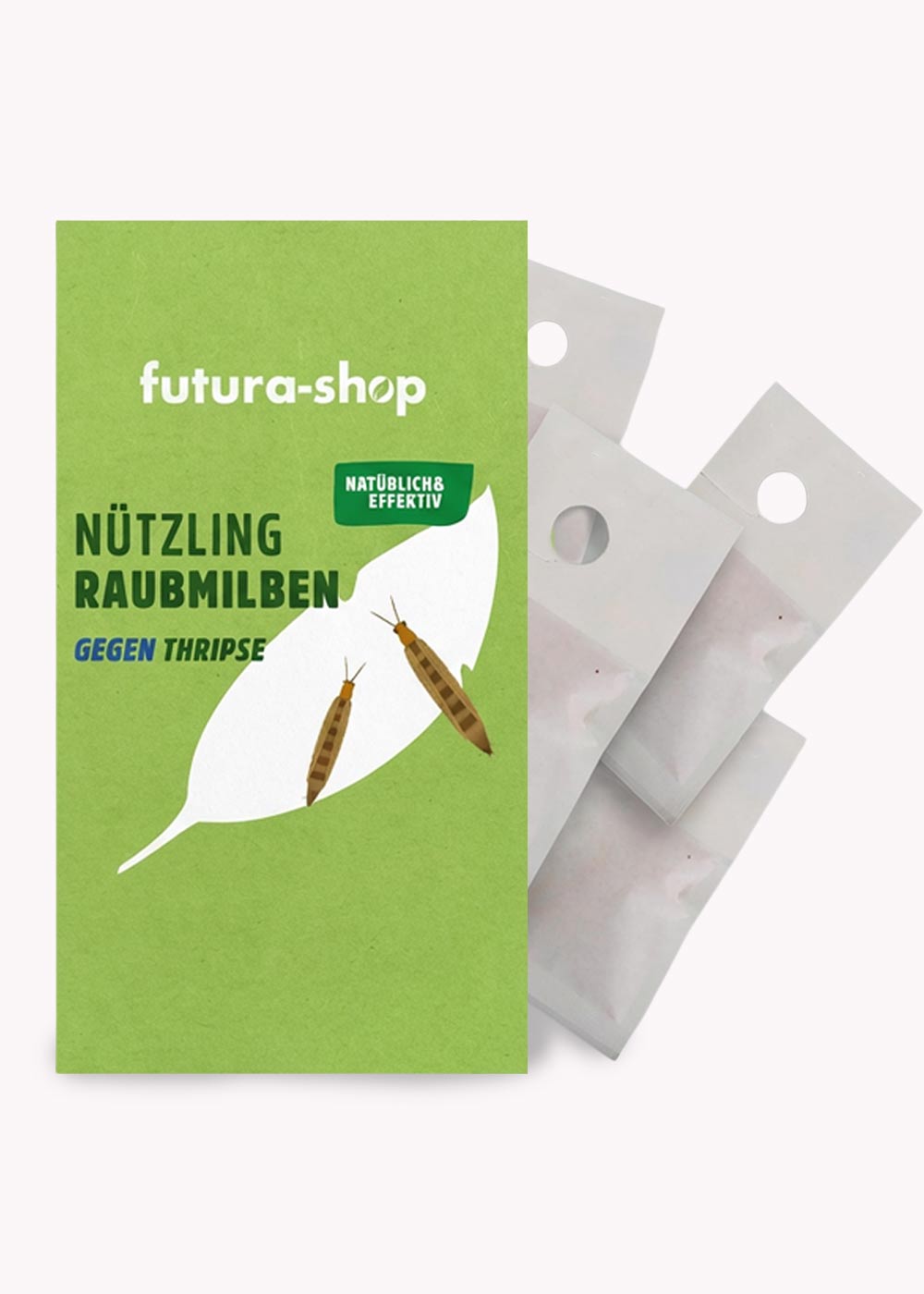

Predatory Mites against Thrips
Available, delivery time: 1-2 Tage

Product information "Predatory Mites against Thrips"
✔ All orders are always dispatched on Tuesdays.
✔ Shipping within Germany only.
✔ Shipping is by letter post (large letter); please check your letterbox regularly.
✔ Regional weather conditions cannot be taken into account.
✔ You will receive a dispatch notification, but no shipment tracking.
We cannot influence the delivery time of letter post.
✔ We accept no liability for undeliverable shipments due to incorrect address details or for deliveries not collected from parcel lockers or post offices.
✔ Once packing has begun, predatory mites are excluded from exchange and withdrawal.
✔ Complaints about the goods are only accepted immediately upon receipt.
Predatory mites against thrips and spider mites
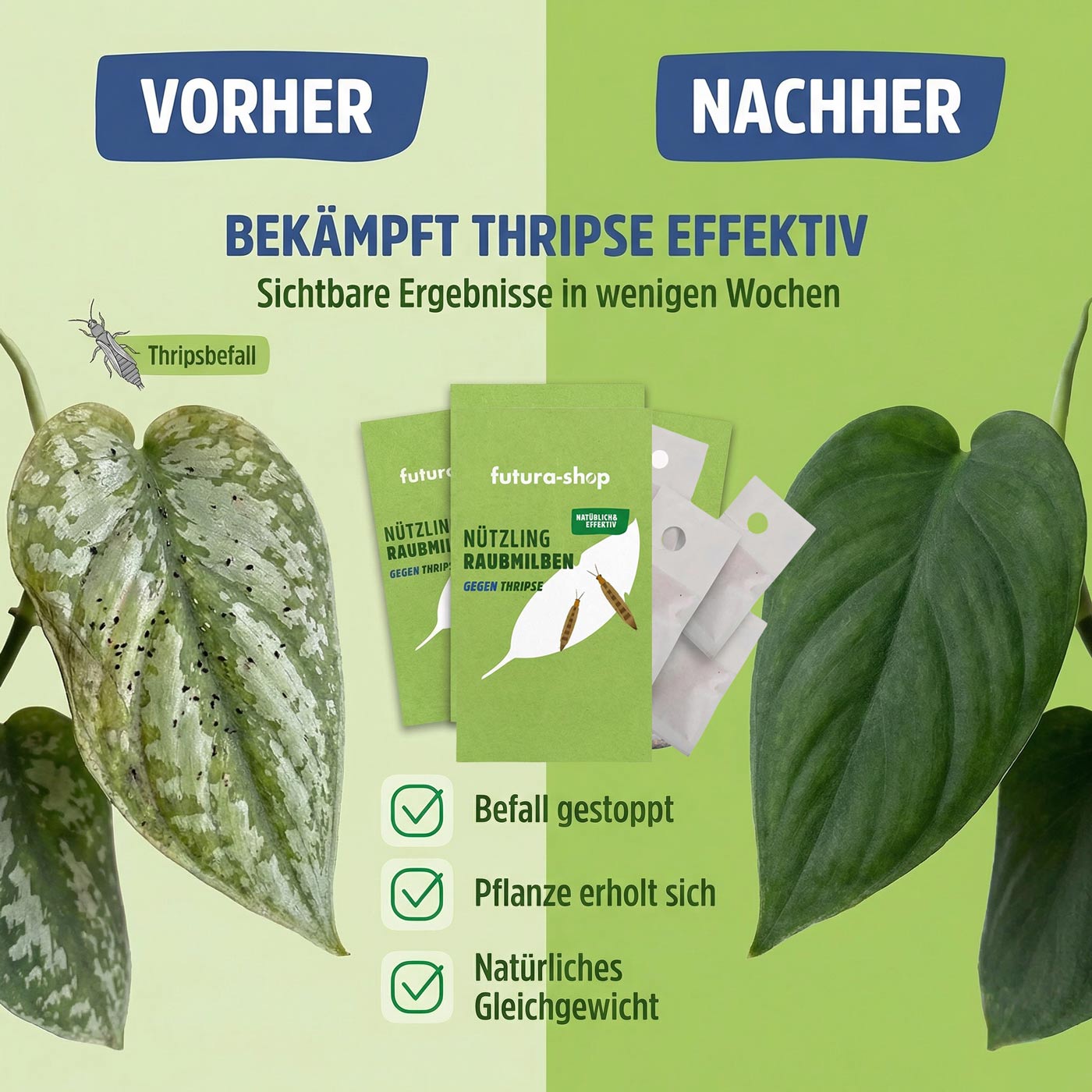
A thrips infestation rarely announces itself. First, pale feeding marks, silvery leaf surfaces or small black droppings appear, then the plants visibly lose vitality. This is exactly where predatory mites against thrips come in: they work biologically, reliably and without chemical sprays. Our predatory mites are living beneficials; they reduce infestation pressure sustainably and are ideal for gentle plant protection indoors, in the greenhouse, on balconies and terraces.
Amblyseius cucumeris preferentially hunts thrips larvae. The predatory mites are about 0.3 to 0.5 mm in size, very mobile and also reach the undersides of leaves, where thrips like to hide. Under suitable conditions, predatory mites can survive longer in the crop by feeding on pollen. This stabilises the effect, especially when infestations recur or when you want to start preventively.
At a glance: what predatory mites achieve against thrips
Predatory mites against thrips work best if you start early. Predatory mites mainly eat young thrips larvae, which interrupts the development of the population. Adult thrips are disturbed, but the focus is on the larval stages, which cause the greatest feeding pressure. Predatory mites are beneficials and at the same time arachnids. They actively search for prey, pierce the larvae and suck them dry. That sounds drastic, but it is exactly the natural mechanism that protects plants in nature – without leaving residues in your surroundings.
For you, this means less damage, less stress for your plants and pest control that fits into your routine without constant spraying.
Recognising thrips: typical symptoms and damage
Many users initially confuse thrips with spider mites or a nutrient deficiency. Looking at the damage pattern helps to classify the infestation correctly so that predatory mites against thrips can be used in a targeted way.
Typical damage on leaves
Thrips rasp the surface and suck plant sap. You will often see silvery, shiny patches, fine pale dots or irregular pale areas. Leaves look dull and “washed out”. Dark droppings often appear as well, usually like tiny peppercorns. With a heavy infestation, new shoots curl, buds remain small and flowers show discolouration.
Thrips infestation on indoor plants
Indoor plants such as Monstera, Ficus, Calathea, Philodendron or orchids often react with limp leaves, weakened new shoots and unsightly pale areas. Especially in warm, dry rooms, thrips can quickly become a permanent burden. Indoors, the advantage of predatory mites against thrips is particularly great, as you can do without chemical products that bring odours, residues or restrictions in everyday life.
Thrips on vegetables, herbs and young plants
Vegetables and herbs can also be affected, for example peppers, cucumbers, aubergines or basil. Here, biological plant protection is often the first choice, as you want to protect edible plants and avoid residues. A rapid response is important. In young plants, an infestation can significantly slow growth and cause long-term damage, such as weak shoots, poorer flowering or lower yields.
How to confirm thrips reliably
Shake affected leaves over a white sheet of paper. Thrips are small, elongated and move quickly. Yellow sticky traps help with monitoring, but they are no substitute for control. If you also see fine webbing, there is often a parallel spider mite infestation. In that case, precise identification is worthwhile, as the strategy differs.
The thrips life cycle: why larval stages and pupae are decisive
Predatory mites against thrips are so effective because they target exactly the stages that feed on the plants. To understand the logic, a brief look at the life cycle helps. Thrips lay eggs in plant tissue. These are followed by larval stages that feed on leaves and flowers. Thrips then move into the prepupal and pupal stages, often in the substrate, in cracks or in the top layer of soil. Only then do adult thrips hatch and spread across the plants again. This means that if you only reduce the visible insects, pupae often remain in the pot and the infestation starts again.
Practical knowledge: where the pupae are
The pupae are often not on the leaves. Many species pupate in the substrate, in saucers, in crevices or near the base of the plant. That is exactly why it makes sense to combine predatory mites against thrips with further measures, especially if the infestation has existed for some time. A good strategy covers both leaves and substrate. This interrupts the cycle and reduces the likelihood of thrips continuing to hatch.
Why predatory mites work so well against thrips
The strength of predatory mites lies in the combination of activity, precision and plant compatibility.
Focus on thrips larvae
Amblyseius cucumeris prefers thrips larvae. This means predatory mites attack exactly where the population is most vulnerable. The earlier you start, the faster the infestation pressure falls. In practice, predatory mites against thrips are ideal for incipient infestations, for recurring problems and as a preventive measure, for example on sensitive indoor plants, ornamental plants or in greenhouses.
Active searching instead of chance hits
Many methods only work where you apply them directly. Predatory mites, on the other hand, move actively, including on the undersides of leaves and in narrow leaf axils. This is an advantage over purely mechanical approaches. As predatory mites are arachnids, they are adapted to climbing on plants. They stay where thrips feed and also search areas that you often cannot reach when spraying.
Amblyseius cucumeris: properties and areas of use
Amblyseius cucumeris is one of the most commonly used predatory mites against thrips. It is robust, mobile and well suited for use on plants. At 0.3 to 0.5 mm, predatory mites are barely visible. You are more likely to recognise them as small, pale dots that move. They pose no problem for plants, as they do not suck plant sap and cause no damage.
When there is little prey, predatory mites can survive longer in the crop under suitable conditions, for example on flower pollen. This helps especially when you work preventively or when thrips occur in waves.
Which predatory mites are there, and when is which species useful?
Not every predatory mite suits every pest. In biological pest control, different predatory mites are used depending on whether thrips, spider mites or other pests dominate. Amblyseius species are often used for thrips, as they reliably find thrips larvae. For spider mites, there are specialised predatory mites that cope particularly well with webbing and dense spider mite infestations.
If you are unsure, the most important question is this: if you mainly see silvery feeding marks and droppings, many signs point to thrips. If you mainly see dot-like pale spots and webbing, spider mites are usually the main driver. In mixed situations, it often makes sense to stagger the strategy: start with predatory mites against thrips first, improve the climate at the same time, then add further beneficials depending on progress.
Predatory mites against spider mites: what is realistic?
Many plants have not only thrips but also spider mites. Spider mites are also arachnids; they cause dot-like pale spots, later yellow leaves and sometimes fine webbing. Predatory mites can provide support in the case of a light mixed infestation, but the greatest strength of Amblyseius cucumeris lies in controlling thrips. With a heavy spider mite infestation, a specialised predatory mite is usually advisable, otherwise control takes unnecessarily long.
Respond early to mixed infestations
If you discover spider mites early, beneficials can help stabilise the infestation. At the same time, you should optimise the climate, as spider mites love dry air and warm locations.
When spider mites dominate
With a heavy spider mite infestation, it is often worth using a specialised predatory mite. It is crucial that your pest control matches the diagnosis; otherwise you invest time without addressing the cause.
Benefits: no chemicals, no residues
• Chemical-free plant protection, ideal for living spaces, balconies, greenhouses, indoor plants and ornamental plants
• Predatory mites against thrips act specifically against thrips larvae, visibly relieving the plants
• Easy application: hang up bags and sachets or sprinkle loose material onto leaves
• Flexible pack sizes, suitable for anything from a few plants to larger crops
• Easy to combine with IPM, hygiene, monitoring and other beneficials
Step by step: how to use predatory mites correctly
For predatory mites against thrips to work optimally, they should be released promptly after arrival. Living beneficials are most active when they are fresh.
Step 1: prepare the plants
Check your plants carefully. Remove badly damaged leaves, dispose of them with household waste and clean the surroundings, for example the windowsill or shelf. This reduces infestation pressure and prevents thrips from hiding in cracks. If several indoor plants are affected, a short quarantine is worthwhile. Place heavily infested plants separately until the predatory mites are visibly working and the pressure falls.
Step 2: prepare the bags and sachets
Store the bags in a cool, dark place if you cannot release them immediately. 8 to 10 degrees is ideal. Do not shake the bags vigorously; gently turning them is enough. Only open the bags among the plants. This prevents predatory mites from getting “lost” in the room instead of working on the plants.
Step 3: hang up the bags – the classic method
You can hang bags or sachets directly among the plants. Place the bags as close as possible to the source of infestation, but not in direct sunlight. Turn each bag briefly and carefully so that the predatory mites are distributed in the carrier material. Then open the bag among the plants and hang it in the plant, preferably in the inner area where thrips hide.
Step 4: apply loose material – targeted on leaf areas
Alternatively, you can use loose material. Here you put the carrier material with the predatory mites directly onto infested leaves or into the leaf axils. Loose material is useful if you see certain plants heavily affected, if you have very dense plantings or if you want to treat individual hotspots. Make sure the material does not fall off immediately; slightly moist leaves can help.
Step 5: correct care after release
Avoid hosing the plants down vigorously immediately after release. The predatory mites should first spread out and settle. When watering, water the substrate as normal. Moderately increased humidity can support the activity of the predatory mites, especially against thrips and spider mites.
Climate, temperature and humidity for maximum effect
Temperatures between 15 and 30 degrees are ideal for predatory mites against thrips. As a guideline, a relative humidity of around 65 per cent applies. In very dry air, predatory mites become less active. At the same time, thrips and especially spider mites often benefit from dryness. Slightly increased humidity therefore shifts the balance in favour of your plants. Release the beneficials in the morning or evening. Avoid direct sun and strong heat so that the predatory mites do not dry out.
Dosage: which pack size suits your needs?
The dosage depends on the number of plants, the severity of infestation and the surroundings. For a light infestation, a smaller quantity is often sufficient; for a heavy infestation, you should start more densely and follow up. As a practical guideline, each bag contains about 1,000 beneficials. Depending on the product variant, you receive bags or sachets that bring the predatory mites safely to where they are needed.
Recommendation by number of plants
• 1 bag, for 1 to 3 plants, preventive or for light infestations
• 3 bags, for 3 to 6 plants, for small plant collections or local outbreaks
• 5 bags, for 5 to 10 plants, for balconies, terraces or small greenhouses
• 10 bags, for 10 to 20 plants, for larger crops and greenhouse areas
Recommendation by infestation pressure
With a light infestation, a few bags are often sufficient if you start consistently. With a moderate infestation, it makes sense to use more bags so that the predatory mites establish a presence on every plant more quickly. With a heavy thrips infestation, the rule is: better more bags at the start than playing catch-up later. A follow-up application after a few weeks is often worthwhile to consistently intercept newly hatching larvae.
How quickly do predatory mites work against thrips?
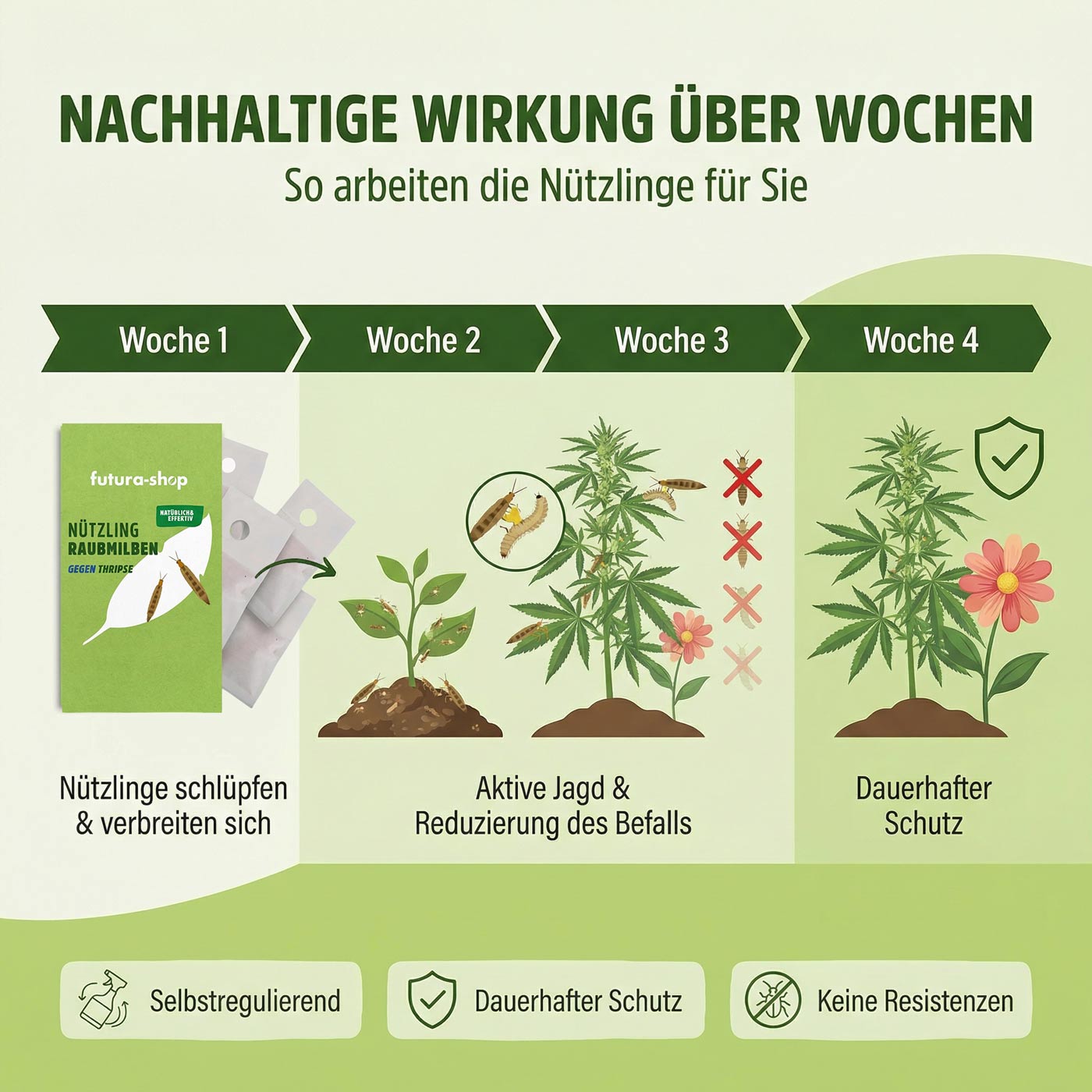
Biological control is not an immediate measure like a contact product. In return, it is sustainable and more compatible with sensitive plants. In the first week, the pressure on new shoots often decreases because the predatory mites find the active larvae. In the second to fourth week, you will usually see more clearly that less damage occurs, new leaves grow more calmly and the pressure decreases.
If you see a large number of adult thrips, pupal stages are often still active in the substrate. In that case, a follow-up application helps, and in some cases an additional measure in the pot, so that the next generation does not start again.
Monitoring success: how to recognise progress
Look out for the following signs:
• New shoots show fewer silvery feeding marks
• The number of droppings decreases
• Leaves look stronger again and less curled
• You see fewer thrips on the white paper when tapping the leaves
Yellow sticky traps can be used for monitoring. They show whether many adult thrips are still active and help you plan the timing of a follow-up application. If you also have spider mites, observe whether the webbing decreases and whether new leaves grow back without dot-like damage. Here too: predatory mites work over time, not overnight.
Common mistakes that slow down the effect
Starting too late
If plants are badly weakened, it takes longer for the crop to stabilise. Predatory mites cannot reverse damage; above all, they prevent new damage.
Too dry
Low humidity makes predatory mites less active and favours spider mites. Especially with indoor plants, it is worth checking the indoor air, particularly in winter or with heating air.
Too few bags
Too low an initial density means that thrips multiply faster than the predatory mites can reduce them. Several small hotspots in one room often need more bags than expected, because thrips jump and spread.
Unsuitable application
If bags hang in direct sunlight or if you spray and hose down heavily shortly after release, the predatory mites lose time and reach.
Combinations in integrated plant protection: IPM in practice
The best results are usually achieved with integrated plant protection. Predatory mites against thrips are a central component, and supplementary measures increase stability.
Predatory mites and nematodes: which are better against thrips?
Many customers ask: are predatory mites or nematodes better against thrips? The answer is usually: both together are most effective. Predatory mites work on the plants and reduce the larval stages. Nematodes can act in the substrate against prepupae and pupae, i.e. against stages that predatory mites often do not reach. Especially with recurring thrips infestations, this combination is strong because it interrupts the life cycle at two points. You thus deploy beneficials where each is most effective.
Hygiene, quarantine, clean surroundings
Isolate heavily infested indoor plants if possible. Clean pots, saucers and the surface they stand on. Remove badly damaged plant parts. Also pay attention to new plants: many thrips enter the collection with new purchases. A short quarantine for new indoor plants protects your existing plants and saves many bags later.
Monitoring with yellow sticky traps – the right way
Yellow sticky traps do not reliably reduce pests, but they help you detect activity. Use them to observe progress and to check whether many adult thrips are still active.
Plant protection products, compatibility and waiting periods
Avoid chemical plant protection products for around six weeks before and during application, as residues can weaken the beneficials. Some oil-based preparations can also impair predatory mites if they adhere directly to the leaves.
If a treatment is unavoidable, check the product's compatibility with beneficials. Only use predatory mites again once the effect has worn off and there are no more relevant residues on the plants.
Handling bags, sachets and loose material: practical tips
Hang bags as centrally as possible in the plant, not on the outer leaf tips. The predatory mites then start in the area where thrips often sit. With several plants in a room, distribute the bags instead of concentrating them all on a single plant. Thrips migrate, and predatory mites need a presence throughout the whole collection. If you use loose material, sprinkle it in small portions onto several leaves instead of putting everything on one leaf. This increases the likelihood that the predatory mites will find prey quickly.
Protect bags from direct watering. If bags become permanently wet, the carrier material suffers and the predatory mites find it harder to migrate out.
Storage, shipping and shelf life of living beneficials
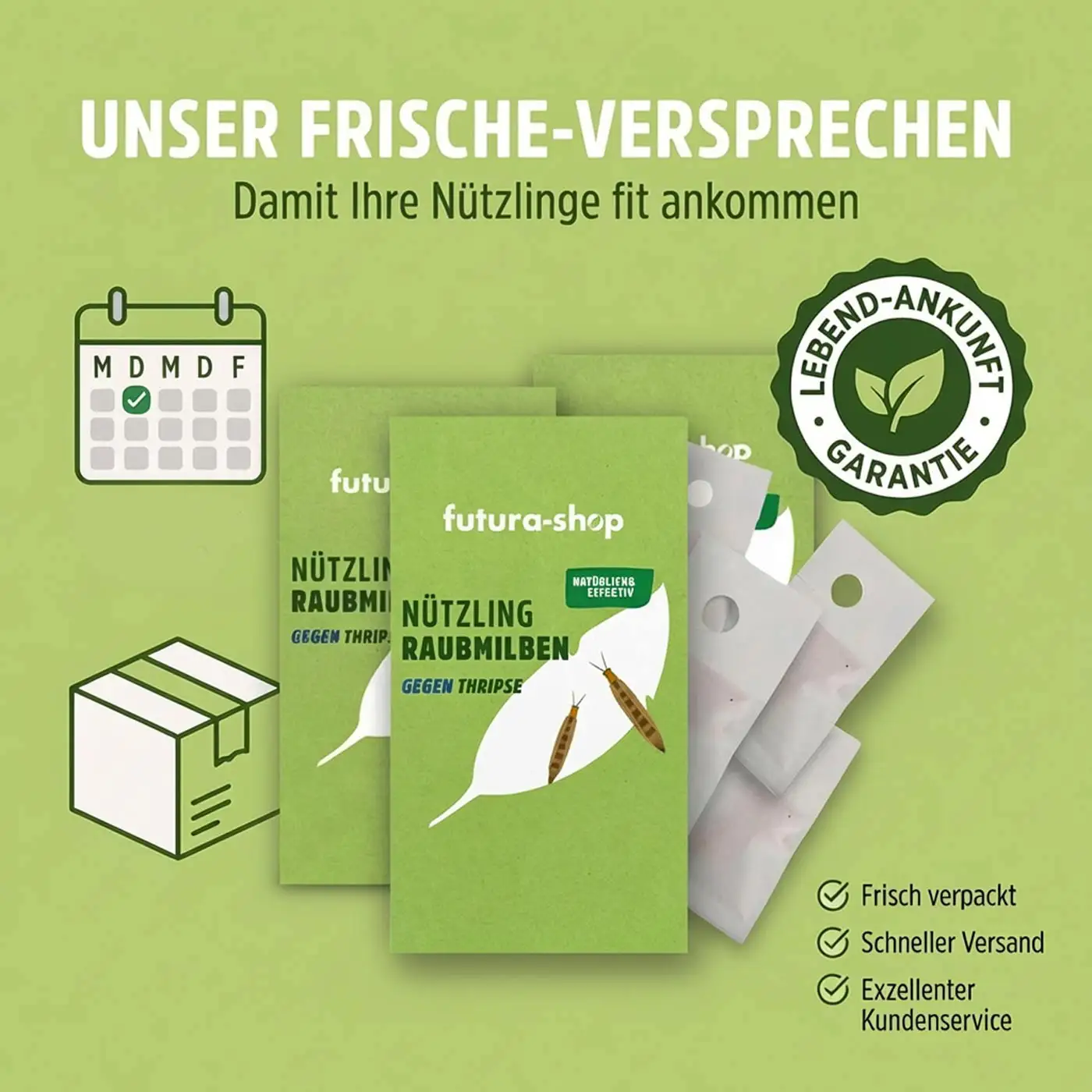
Predatory mites are living beneficials. Plan the delivery so that you can release the bags promptly. For short-term storage: cool and dark, ideally 8 to 10 degrees. Do not freeze the bags, and do not store them in warm places such as on the radiator or in direct sunlight.
If you receive several bags, do not open them all at once if you only want to use some of them immediately. Use the bags you need first and keep the remaining bags cool for a short time.
Safety in the home, living spaces and with pets
Predatory mites are harmless to people and pets when used as intended. They are specialised in small pests and have no interest in food, textiles or stores. As with many natural products, allergy sufferers should avoid unnecessarily stirring up the carrier material. When using carrier material, you can wear gloves if necessary and ventilate briefly after application.
Beneficials and pests: a practical overview
If you discover pests on your plants, a clear classification helps to keep control targeted. Many pests cause similar damage, but they react differently to climate, care and beneficials.
Thrips and spider mites are among the most common pests on indoor plants. Both pests like to sit on the undersides of leaves, both multiply quickly in warm conditions, and both cause visible damage to plants. That is exactly why beneficials such as predatory mites are so popular: they work directly on the plants without you having to burden your rooms with sprays.
How to use beneficials as a system rather than a one-off measure
• Detect pests early, check plants regularly, especially the undersides of leaves
• Plan control, release beneficials immediately, use sufficient bags
• Consider pests throughout the room, distribute bags across several plants
• Stabilise control, improve the climate, let the beneficials keep working
• Monitor pests, use yellow sticky traps for monitoring, observe plant growth
Mini guide: which beneficials suit which pests
• Thrips: control with predatory mites against thrips, bags or one sachet per group of plants
• Spider mites: control with suitable predatory mites depending on pressure, also improve humidity
• Whiteflies: control often with specialised beneficials, depending on the crop
• Aphids: control often with beneficials such as parasitic wasps or ladybird larvae
• Fungus gnats: control with beneficials in the substrate, especially for young plants and vegetables in pots
The order is important: start with the pests that weaken your plants the most and use beneficials to match. This keeps control efficient and reduces new damage before your plants suffer permanently.
Finding the causes: how to avoid renewed infestation
Thrips rarely come “out of nowhere”. Common sources of introduction are new indoor plants, cut flowers, open windows during warm periods or plants that stood outside in summer and are brought back indoors in autumn. Reduce stress for your plants: weakened plants are more susceptible to pests. Ensure sufficient light, appropriate watering and clean substrate. Check the undersides of leaves regularly. An early find saves many bags later and speeds up control.
Which plants are predatory mites particularly suitable for?
Predatory mites against thrips are suitable for a very wide range of plants, as they do not damage the plants and require no spray load. This is particularly practical for indoor plants, as there are often many plants in a small space and conventional products quickly become unpleasant indoors.
Suitable plants include ornamental plants, tropical indoor plants, foliage plants and flowering plants. Herbs and vegetables in pots also benefit, for example basil, chilli, peppers or cucumbers in a mini greenhouse. It is important that the plants do not stand permanently in blazing sun, as heat and dry air are unfavourable for predatory mites. If you have several plants, distribute the bags and sachets across the entire collection. This way, the predatory mites find the pests faster and control is more even, because every plant comes into contact with beneficials early on.
When several pests occur at the same time: how to stay in control
In practice, thrips rarely come alone. You often find spider mites at the same time and, depending on the environment, aphids or whiteflies too. Such pests exploit every stress phase of the plants, for example after moving, after repotting or in dry heating air.
The advantage of biological control with beneficials is that it is easy to combine. Predatory mites are a central component, and depending on the pests, further beneficials can be added without you having to treat your plants constantly. This creates a stable balance that protects your plants in the long term. Set a clear priority: if thrips are the main problem, start with predatory mites against thrips. If spider mites clearly dominate, add targeted measures. A clean diagnosis saves bags, speeds up control and reduces new damage to the plants.
Practical tip for implementation
Hang at least one sachet visibly in each group of plants so you keep track. Note the date so that you can follow up in a structured way if pests are still active. Also keep an eye on the undersides of leaves, as thrips and spider mites particularly like to hide there.
What is most effective against thrips: a practical plan
If you want to get thrips under control quickly and sustainably, this procedure has proven itself:
Confirm the thrips infestation and check the plants thoroughly
Remove badly damaged leaves, clean the surroundings
Release predatory mites against thrips promptly, use sufficient bags and sachets
Optimise the climate: temperature in the target range, moderately increase humidity
Monitor with yellow sticky traps, check new shoots
Follow up after a few weeks if necessary, especially with heavy thrips infestations
Optionally use nematodes in the substrate if the infestation recurs or if many pupal stages are suspected
This is how you combine biological control and clean plant protection into stable pest control that works in the long term.
FAQs
How effective are predatory mites against thrips?
Predatory mites against thrips are very effective if you start early and the dosage matches the number of plants. They mainly reduce thrips larvae and lower the infestation pressure over several weeks. With a heavy thrips infestation, a follow-up application is often advisable.How do I use predatory mites correctly?
Release the bags or sachets promptly after arrival. Hang the bags among the plants or use loose material for targeted leaf areas. Ensure temperatures between 15 and 30 degrees and a humidity of around 65 per cent.What is most effective against thrips?
The most effective approach is a combination of early detection, a sufficient number of predatory mites, a suitable climate, hygiene and monitoring. With recurring infestations, combining them with nematodes in the substrate is particularly effective, as pupal stages are also covered.Are predatory mites or nematodes better against thrips?
Predatory mites act on the leaves against larval stages, nematodes act in the substrate against prepupae and pupae. In many cases, the combination is better than just one method.Do I always have to hang up the bags or can I sprinkle the material?
Both are possible. Hanging is practical and even; loose material is useful if you want to treat specific leaf areas.Can I store the bags briefly if I cannot release them immediately?
Yes, for a short time in a cool, dark place, ideally 8 to 10 degrees. Nevertheless, release the predatory mites as soon as possible so that they remain active and vital.
| Hersteller | |
|---|---|
| Futura GmbH Nikolaus-Otto-Str. 22 33178 Borchen Deutschland Telefon: +49 5251 69161-79 E-Mail: info@futura-shop.de |