

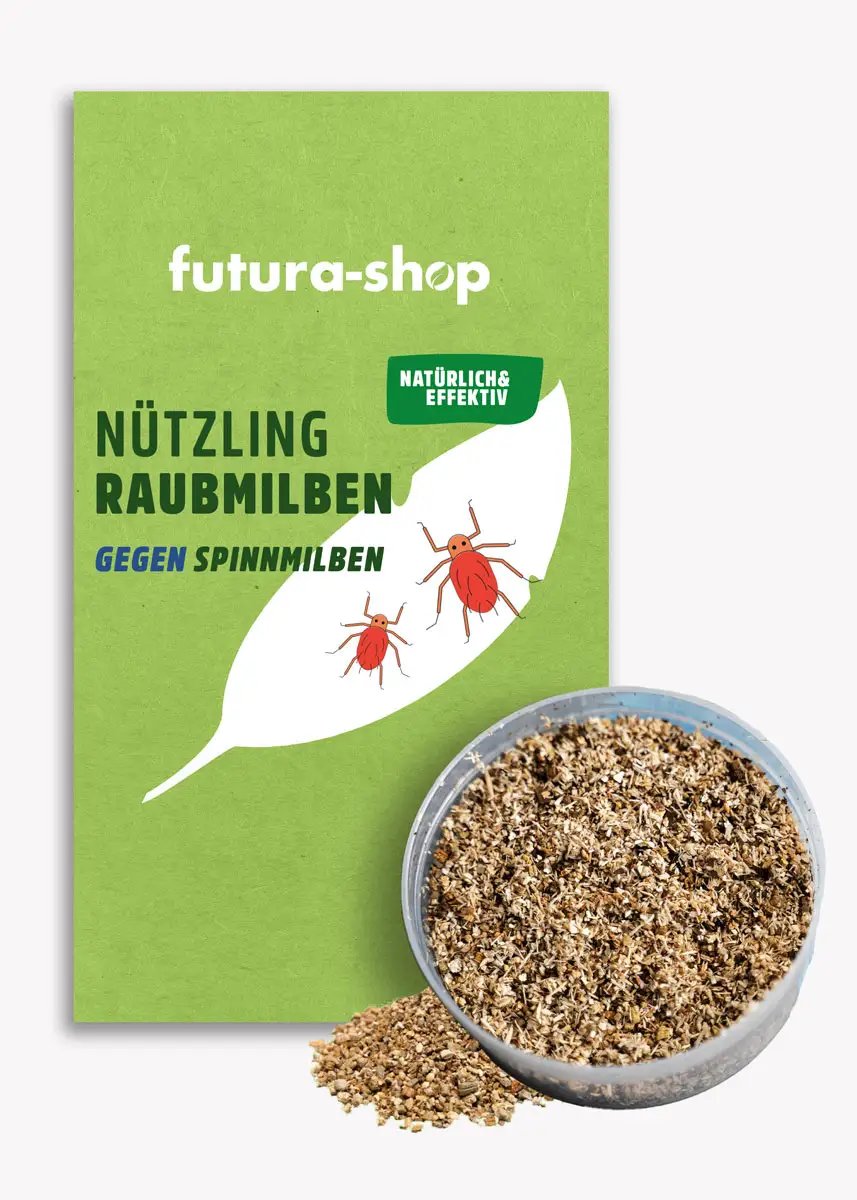




Predatory Mites | Beneficials against Spider Mites
Available, delivery time: Versand jeden Dienstag

Product information "Predatory Mites | Beneficials against Spider Mites"
Please note: Shipping is only possible within Germany! No delivery to parcel lockers!
Predatory mites against spider mites
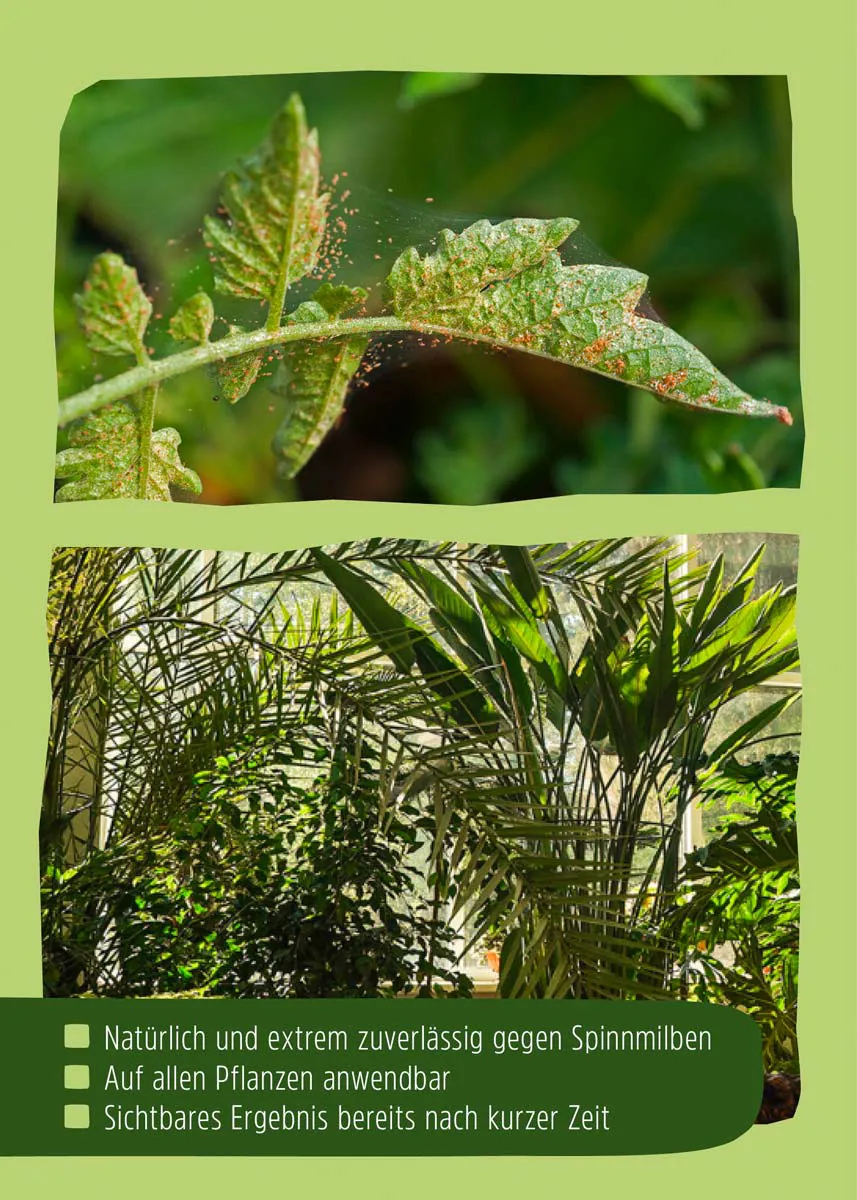
Using predatory mites against spider mites on foliage plants is one of the most natural ways to control spider mites. The beneficials feed on the two-spotted spider mite and the red spider mite. PP predatory mites (Phytoseiulus persimilis) and AC predatory mites (Amblyseius cucumeris) are used above all as a mix against spider mites to achieve the best results. Predatory mites are protective predators: they settle in a crop for a longer period to keep a pest population in check. Simply distribute the predatory mites on the infested plants and let them do their work. These small predators not only help against spider mites, they are also frequently used against fungus gnats, thrips and whiteflies.
Benefits at a glance
✔ Natural pest control: Predatory mites are beneficials and therefore the most natural way to control pests.
✔ Non-toxic: Thanks to natural control, no poisons are needed.
✔ Efficient: A female predatory mite can kill 5–7 spider mites per day.
✔ Easy to use: Simply distribute the tiny creatures on the affected plants according to the instructions.
Scope of delivery
1 tub with approx. 500 predatory mites of the species Phytoseiulus persimilis and Amblyseius cucumeris
Using predatory mites and their advantage over other products:
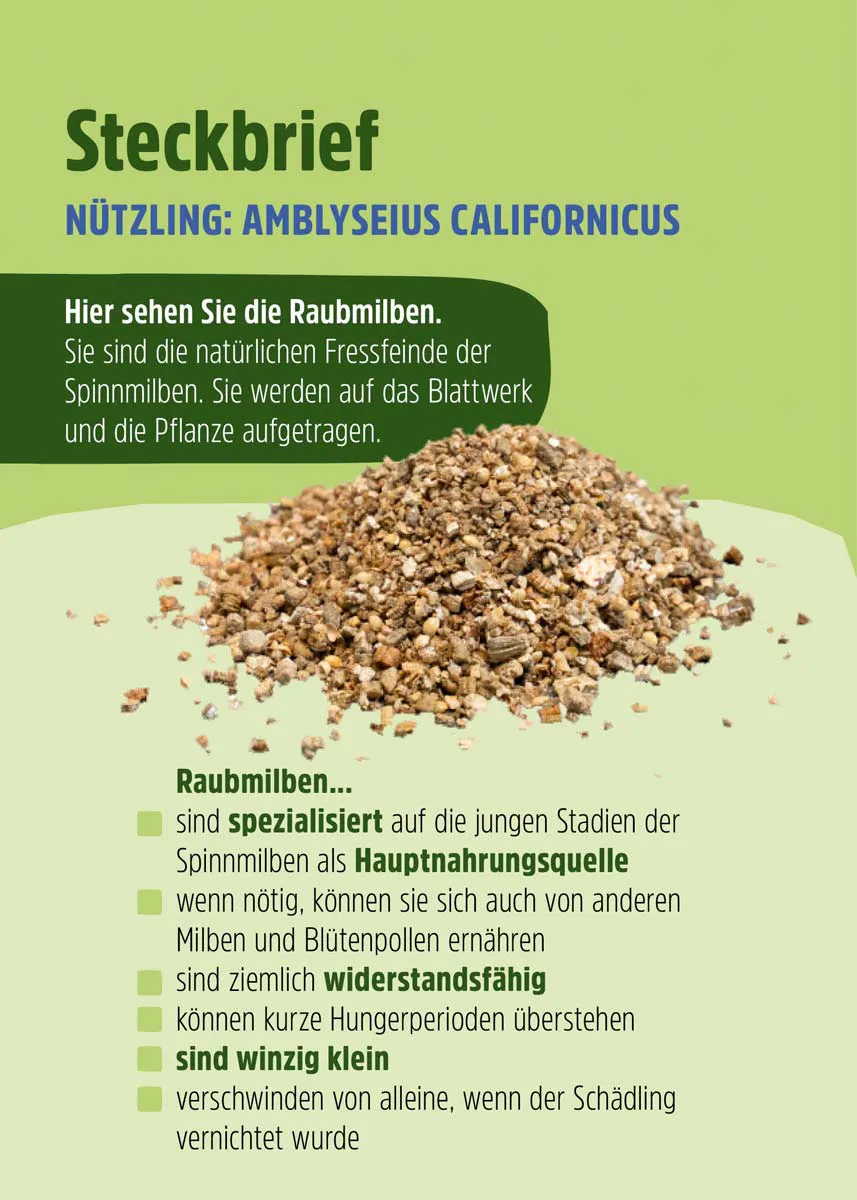
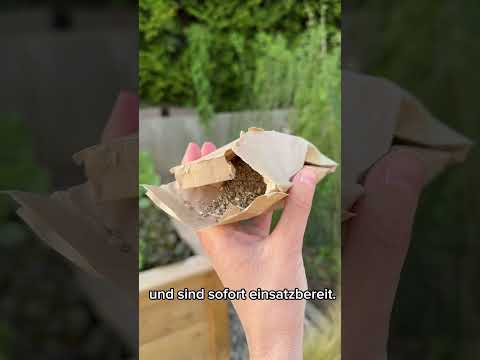
The beneficials are supplied ready for use in wood shavings; the tub contains approx. 500 animals. The chaff mixed with predatory mites is simply sprinkled onto large leaves of the infested crop plants. If the leaves are very smooth, it is advisable to moisten them slightly beforehand so that the beneficials stick to them with the chaff. From then on, the predatory mites take over the work. They pierce spider mites with their mouthparts and suck them dry. The development stage of the spider mite makes no difference. This is what makes predatory mites so effective against the pests compared with chemical products. The release of predatory mites should be repeated after 2 weeks.
Download instructions (German)
What do predatory mites look like?
There are many different species of predatory mites, and not all are equally suitable for pest control. However, the species that work well against spider mites and fungus gnats as well as against thrips and whiteflies are quite similar in appearance. Predatory mites grow to just under 0.6 mm. The larvae are considerably smaller than the adults, so you have to look quite closely to spot them. Their body is pear-shaped and yellowish to reddish-brown in colour. The surface is smooth.
Females of Phytoseiulus persimilis produce between 50 and 100 eggs. The predatory mite needs a temperature of at least 18°C for its development. A temperature of 25°C should not be exceeded. As for humidity, the predatory mite prefers a relative humidity of 70–75% over several hours. As these conditions are found above all in protected cultivation, such as glasshouses or polytunnels, use there is particularly effective.
However, you can also create these ideal living conditions indoors. When using predatory mites indoors, it is best to spray the leaves of the plant infested with spider mites several times, as this increases the humidity. After about 3 days, six-legged larvae hatch. The larvae are inactive on the first day. By the following day, they have already developed into eight-legged nymphs. The development time depends on the temperature: at 21°C it is 7 days and at 25°C only 5 days. Adult predatory mites live for about four weeks.
Why are spider mites so harmful to plants?
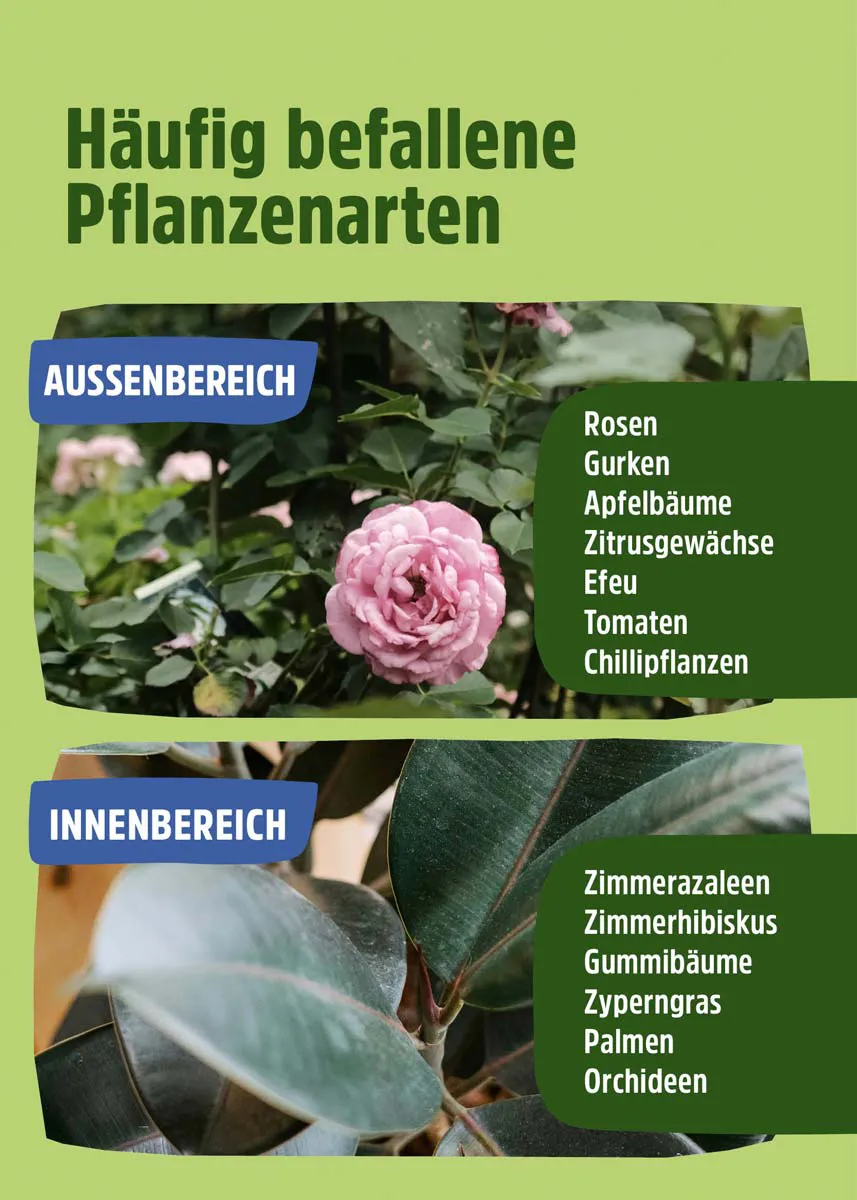
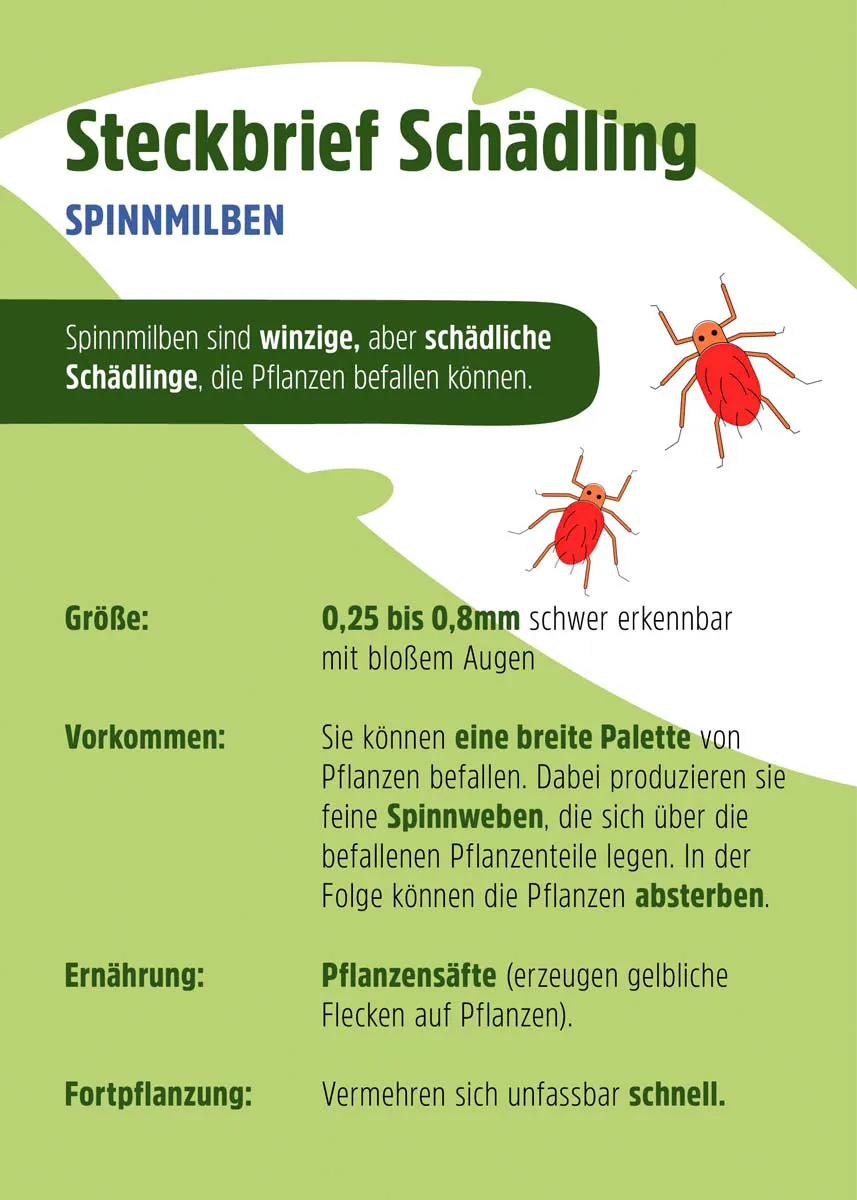
Spider mites feed on the sap of their host plant. They pierce plant cells with their mouthparts and suck out the liquid. As a result, the affected part of the plant dies because important nutrients are missing. These puncture sites show up as pale spots. The leaves of the plant curl up and eventually die off completely. Spider mites can also transmit plant viruses, which can lead to growth disorders, stunting, deformation of flowers and fruit and premature death of the plant. These virus vectors are therefore feared above all in horticulture and agriculture. Nevertheless, it is better to use beneficials such as predatory mites rather than insecticides, as otherwise beneficial insects that are important to us humans are also put at risk.
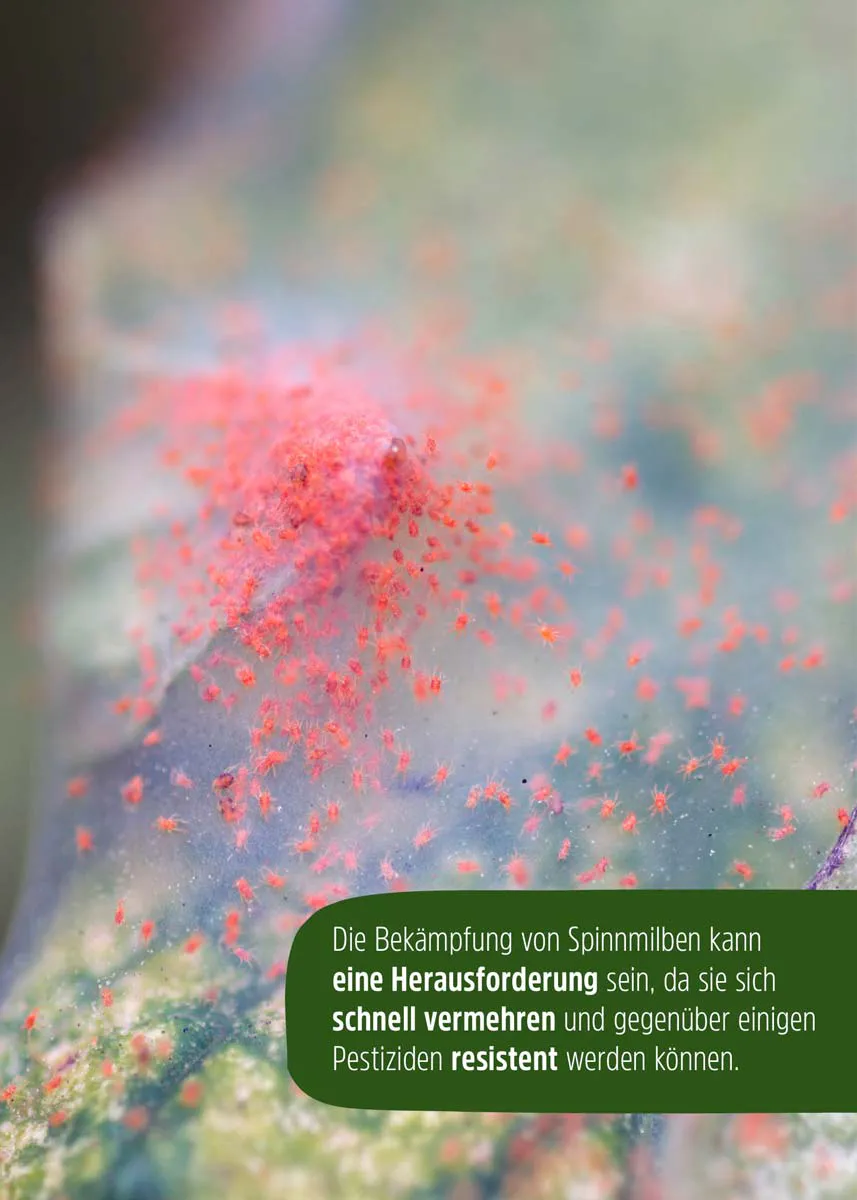
Spider mites love dry, warm weather. Under these optimal conditions, they multiply very quickly. In greenhouses and indoors, spider mites are able to reproduce all year round thanks to the constantly warm, dry conditions. Female spider mites can lay up to 100 eggs in their lifetime, mostly on the underside of the leaves. The development time of spider mite larvae is 6 to 15 days. Above all in summer, they are also found outdoors, as warm, dry conditions then prevail in the open air too. Outdoors, fertilised spider mite females are able to overwinter in areas protected from the weather, above all under bark scales and in cracks in vine posts. When temperatures rise again in spring, spider mites multiply en masse and the cycle starts all over again.
How do I recognise spider mites?
There are around 1,200 species in the spider mite family. Like all mites, they are arachnids. Like many arachnids, spider mites produce a fine web, which they spread over the entire plant they have infested. This is one of the signs by which you can recognise a spider mite infestation. Although spider mites are only up to 0.8 millimetres in size, you can often see them with the naked eye. Their body is oval and coloured according to species and season: spider mites can be pale green, yellowish green, orange or reddish-brown. So do not rule out a spider mite infestation just because they have a different colour in a new infestation. The two-spotted spider mite causes major damage above all to crop plants. In vegetable growing, it can impair the growth of beans, peas, cucumbers, peppers, tomatoes and maize, and in arable farming it can cause major damage to potatoes.
In fruit growing and viticulture, the fruit tree red spider mite, also known as the European red mite, is common. As the name suggests, these arachnids are reddish in colour and live on the underside of fruit tree leaves. There, too, a spider mite infestation can be recognised by discoloured leaves, which often take on a pale greenish or yellowish colour. In fruit trees, a heavy infestation mainly impairs the formation of fruit buds. In grapevines, it can lead to defoliation, which in turn results in losses in yield and quality. In apple growing, a heavy spider mite infestation specifically leads to smaller fruit and impaired fruit colouring. In viticulture, the infestation affects the must weight.
Not all predatory mites are the same
You should know that not every predatory mite species can be used as a beneficial against spider mites. For many small pet owners, one particular predatory mite species is a source of fear rather than benefit: mites of the species Cheyletiella parasitivorax infest small animals such as rabbits and feed on their skin secretions. Especially in weakened animals, the infestation causes symptoms such as hair loss on the neck and shoulders. Because the skin barrier is weakened by hair loss, secondary infections can occur that make the animal seriously ill. If you want to buy predatory mites for a spider mite infestation, make sure that the species is genuinely suitable for biological pest control.
| Hersteller | |
|---|---|
| Futura GmbH Nikolaus-Otto-Str. 22 33178 Borchen Deutschland Telefon: +49 5251 69161-79 E-Mail: info@futura-shop.de |