

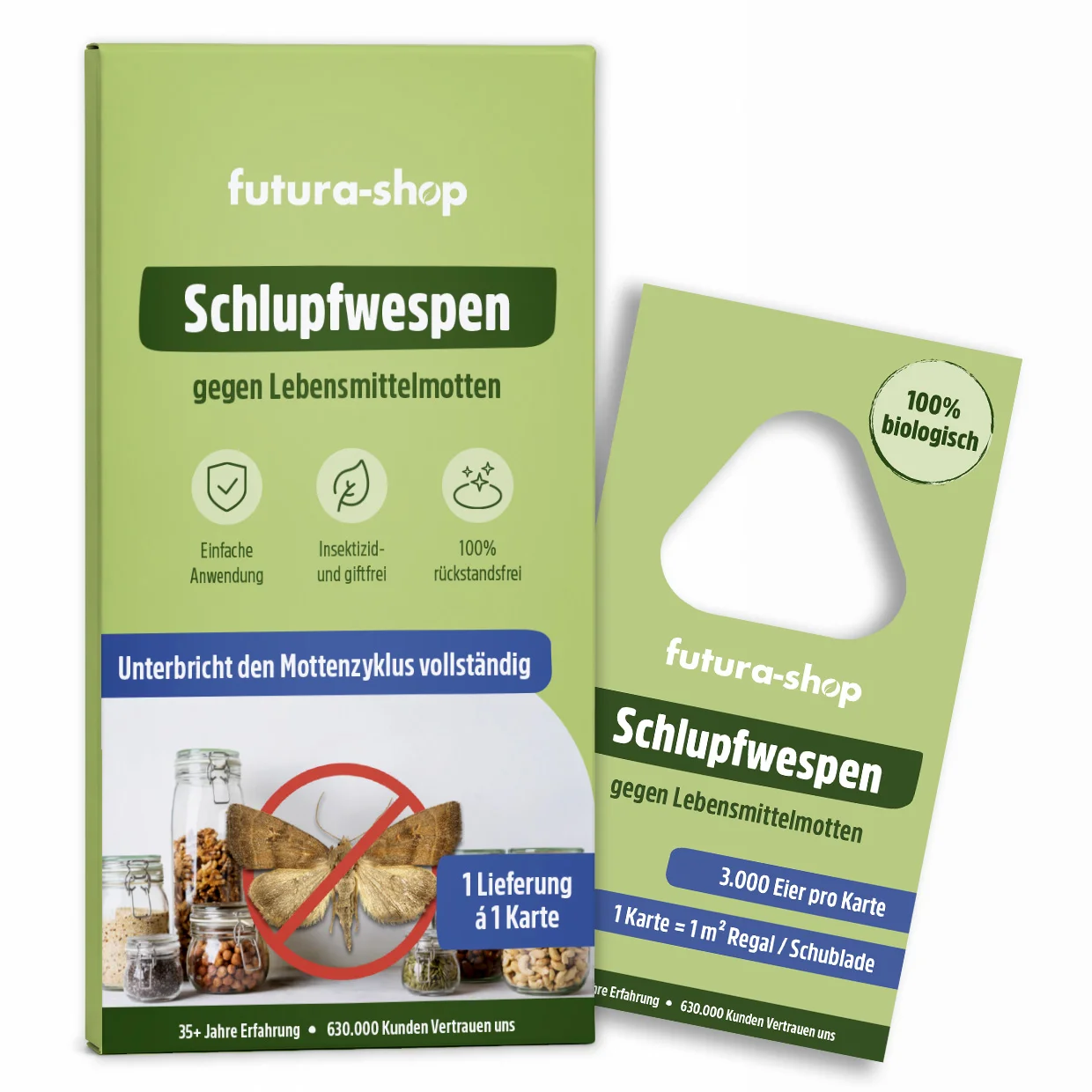




Parasitic Wasps against Pantry Moths
Available, delivery time: Versand jeden Dienstag

Product information "Parasitic Wasps against Pantry Moths"
✔ All orders received by Monday, 10 a.m. are dispatched on the following Tuesday.
✔ Shipping within Germany only.
✔ Shipping is by letter post (large letter); please check your letterbox regularly.
✔ Regional weather conditions cannot be taken into account.
✔ You will receive a dispatch notification, but no shipment tracking.
We cannot influence the delivery time of letter post.
✔ We accept no liability for undeliverable shipments due to incorrect address details or for deliveries not collected from parcel lockers or post offices.
✔ Once packing has begun, parasitic wasps are excluded from exchange and withdrawal.
✔ Complaints about the goods are only accepted immediately upon receipt.
How do I get rid of pantry moths?
In the video, WEINSECT, an influencer known on TikTok for insect and pest control, explains how to control pantry moths effectively:
Moth control without poison
The parasitic wasp (a beneficial insect) eliminates pantry moths in kitchens and storerooms. The beneficial insects are hygienically safe, simple and easy to use and very effective. 100% eradication of pantry moths is possible within 9 weeks. Moth control with parasitic wasps is a very discreet method of moth control without additional effort or disruptive side effects.
Your benefits
✔ completely non-toxic and harmless
✔ practically invisible
✔ no disturbance or nuisance
✔ hygienically safe
✔ simple and easy to use
✔ very effective
Scope of delivery
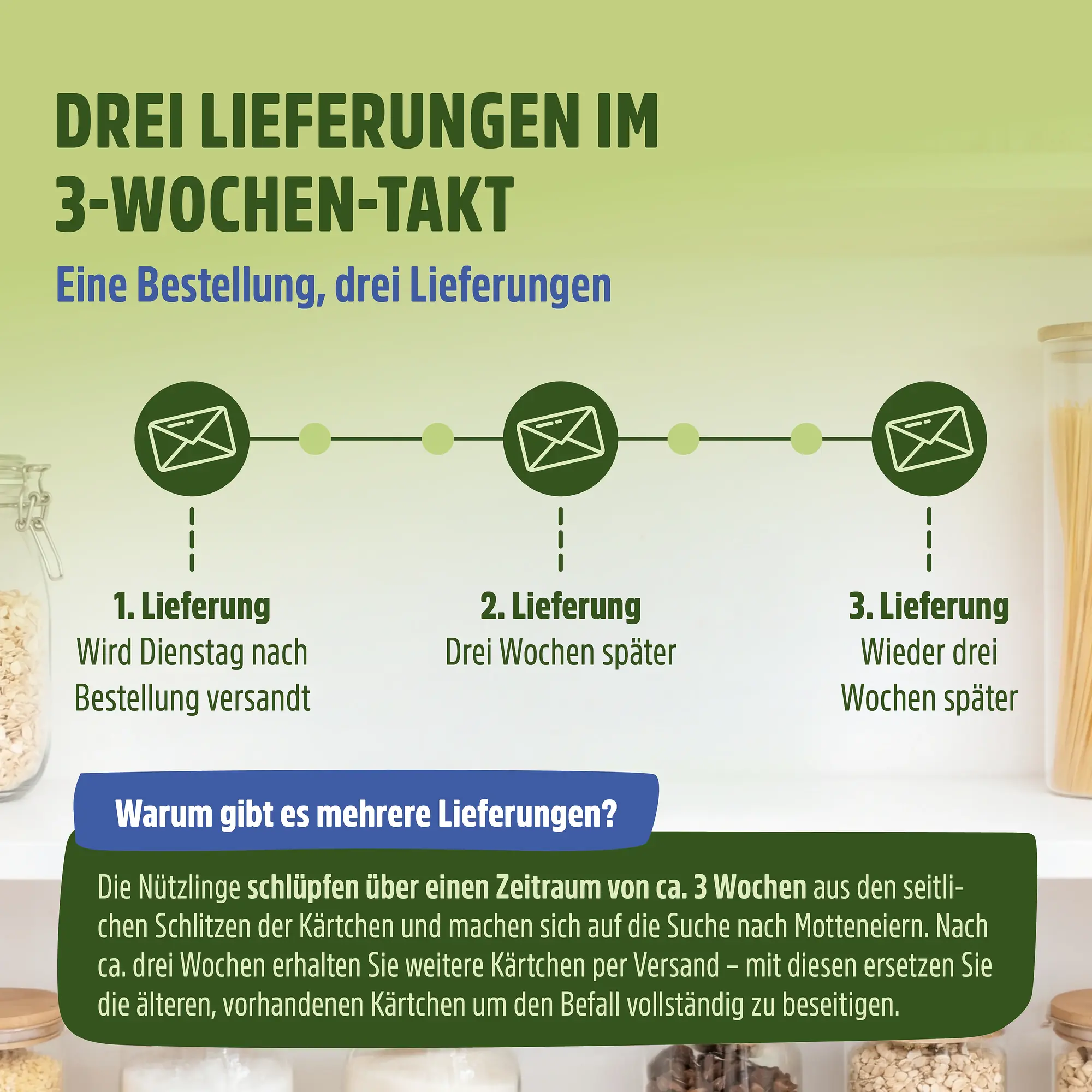
3 deliveries of "fresh" parasitic wasp eggs (approx. 3,000 per card) at three-week intervals within 9 weeks. We always dispatch on Tuesdays as standard.
3 x 1 card = 1 card each, i.e. 3 cards in total.
3 x 2 cards = 2 cards each, i.e. 6 cards in total.
3 x 3 cards = 3 cards each, i.e. 9 cards in total.
3 x 4 cards = 4 cards each, i.e. 12 cards in total.
3 x 5 cards = 5 cards each, i.e. 15 cards in total.
3 x 6 cards = 6 cards each, i.e. 18 cards in total.
3 x 7 cards = 7 cards each, i.e. 21 cards in total.
3 x 8 cards = 8 cards each, i.e. 24 cards in total.
3 x 9 cards = 9 cards each, i.e. 27 cards in total.
3 x 10 cards = 10 cards each, i.e. 30 cards in total.
How do I use the parasitic wasps and how do they work?
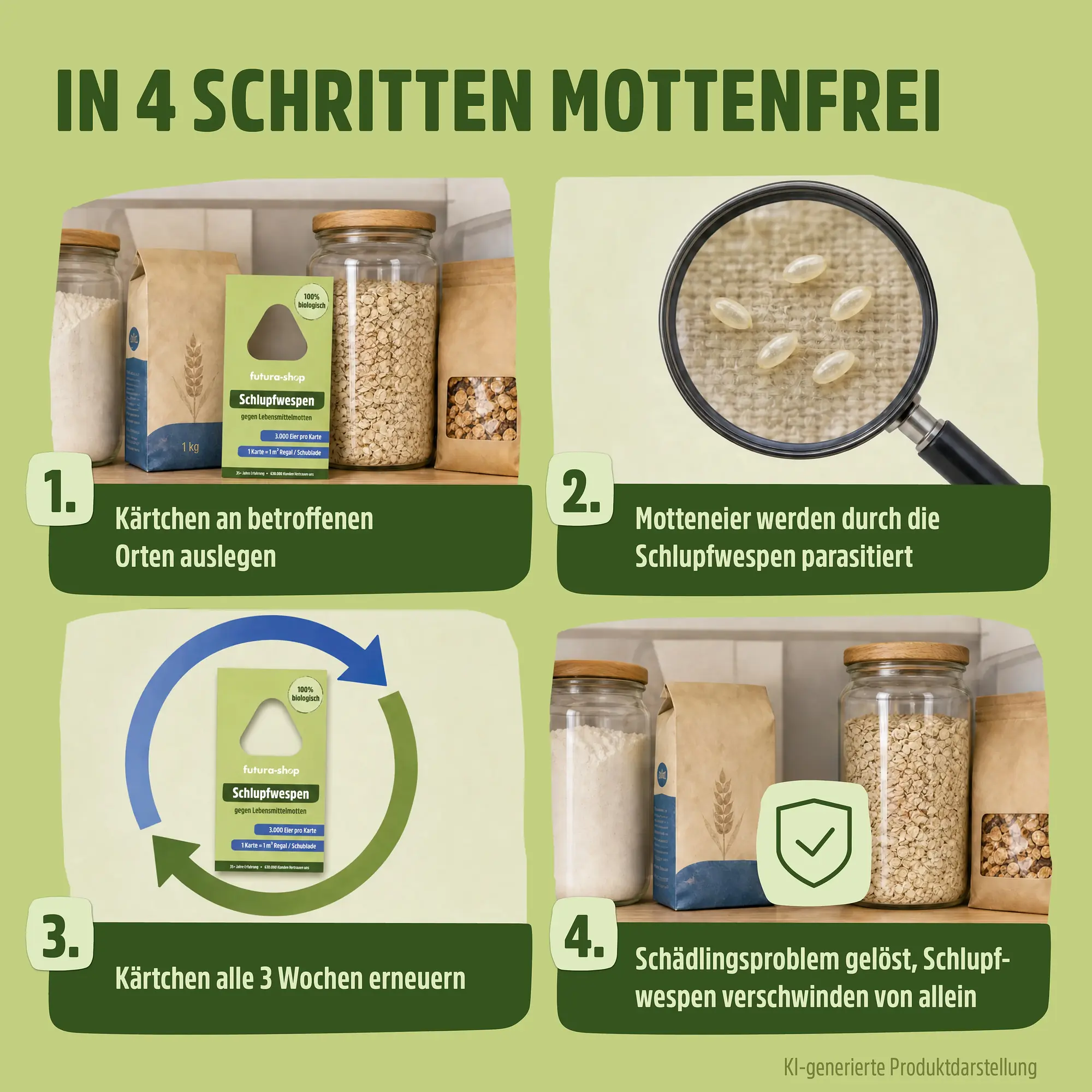
The parasitic wasps are on the cards. These small beneficial insects are bred specifically for household use. The cards are distributed in the kitchen or pantry near the food at risk. It is particularly important that the cards are placed in the right spots where the infestation is, as this is the only place where the moths lay their eggs. As a rule, one card is sufficient for a shelf one metre wide or an enclosed cupboard compartment. The beneficial insects hatch from the side slits of the cards over a period of approx. 3 weeks and go in search of moth eggs. After approx. 3 weeks, you will receive further cards by post – use these to replace the older cards.
The application period of approx. 9 weeks is necessary because a moth's development cycle is completed once in this period. As the beneficial insects only kill eggs, the cards must be put out until all existing caterpillars and pupae or moths have developed into adult moths. The eggs of these moths are then parasitised, so that the next generation of pests fails to appear. If the area at risk is so large that the cards are not sufficient, more cards must be ordered accordingly.
Buying parasitic wasps against moths – what to bear in mind
As these small beneficial insects live for a maximum of two weeks, they should be released as soon as possible after delivery. They then look for moth eggs in their surroundings and lay their own eggs in them. Note that a single treatment is usually not sufficient due to the life cycle of the moths. Instead, parasitic wasps should be put out every three weeks over a period of nine weeks. Even if it sounds strange at first that you can buy these tiny wasps online and that they are then sent by post like a letter, as professionals in pest control we have taken the necessary precautions to ensure that nothing happens to the insects.
General information on parasitic wasps on cards
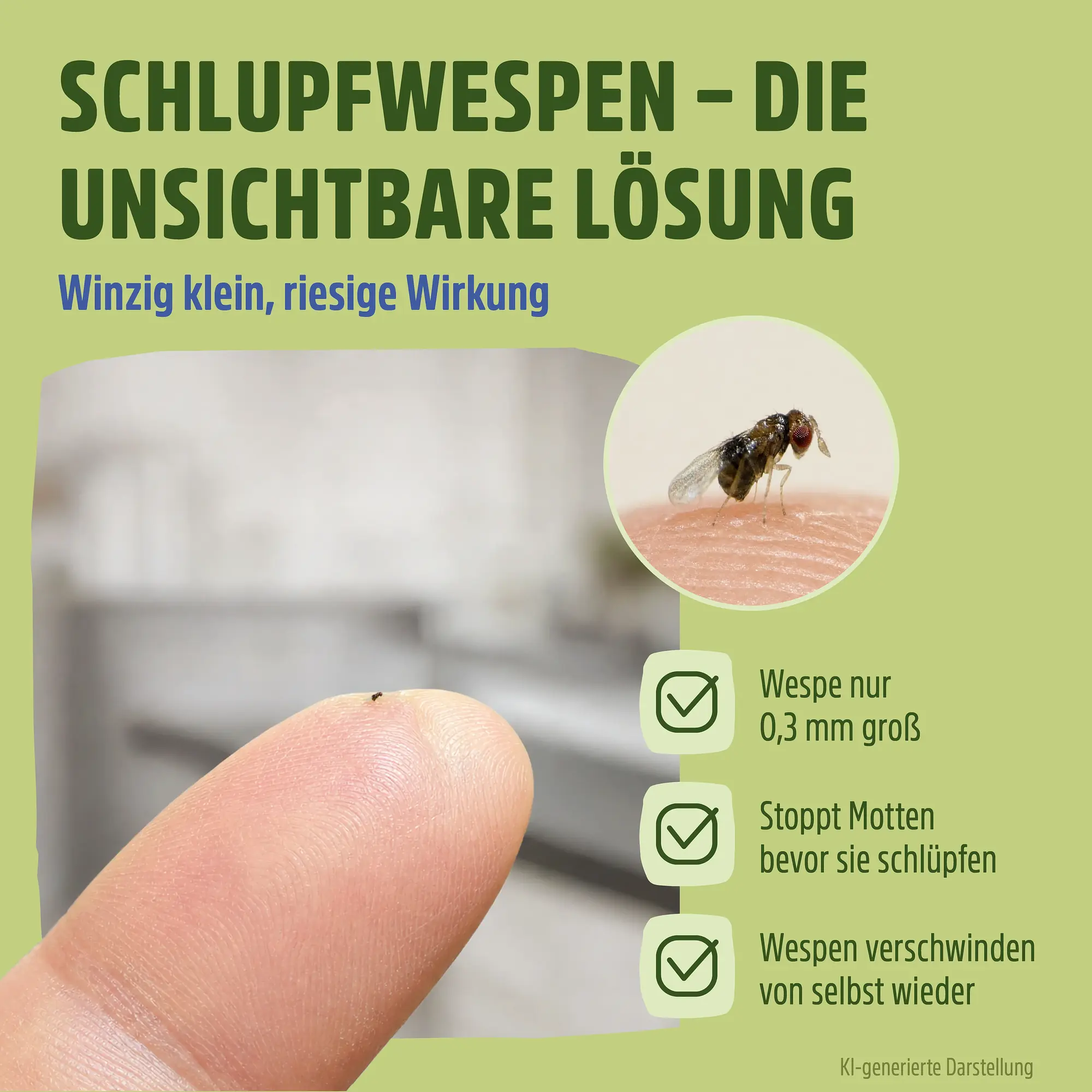
The parasitic wasps (Trichogramma evanescens) are tiny, approx. 0.3 mm. They are so small that you can hardly see them. They are a special genus of insects and are not related to the familiar yellow-and-black wasp. They are completely harmless to humans. They cannot sting. The tiny wasps are theoretically able to fly, but they do not; instead, they move around by crawling.
At normal room temperature, these beneficial insects live for 7–10 days. They depend on the presence of moth eggs, in which they lay their own eggs. This kills the moth eggs, and after about 8–10 days small new beneficial insects emerge. These disappear when they can no longer find any moth eggs. You will never be disturbed by an accumulation of parasitic wasps, as 1,000 insects (air-dried) weigh only approx. 0.002 g.
Target pests
Infestation by pantry moths (including Indian meal moth, Mediterranean flour moth, warehouse moth), in special cases also clothes moths and wax moths. Buying parasitic wasps against moths is an effective, biological and non-toxic way to put an end to these pests.
General information on the pest
In households, the Indian meal moth is the most common. The actual pests are the voracious caterpillars, the larvae of the pantry moths. Only they feed, and only they can actively eat their way through paper or plastic packaging with their mouthparts. As the caterpillars are still very small immediately after hatching from the egg, their holes cannot yet be seen – only the large ones when they leave the packaging (approx. 2 mm in diameter). The adult moths do not feed themselves and are only responsible for reproduction and dispersal: they mate and lay their eggs in suitable places. In doing so, they use their incredibly good sense of smell: moths can smell members of their species and food sources from kilometres away!
The moths lay their eggs on or near food; as they have no ovipositor, they usually stick them directly to the outside of the packaging. The caterpillars, which hatch after a few days, eat a tiny hole in the packaging and immediately start their destructive feeding inside. After a short time, the infestation can easily be recognised by the webs left behind by the caterpillars. After approx. 4–5 weeks of voracious activity at approx. 25°C, the pest enters the pupal stage (the caterpillars spin a cocoon). To do so, they like to leave the food; the caterpillars, up to 15 mm long, can often be seen crawling up walls on their way to suitable pupation sites. After approx. 9 days, the next generation of moths hatches and the cycle starts all over again.
You can find more products from our futura-shop brand here.
| Hersteller | |
|---|---|
| Futura GmbH Nikolaus-Otto-Str. 22 33178 Borchen Deutschland Telefon: +49 5251 69161-79 E-Mail: info@futura-shop.de |
Schlupfwespen gegen Lebensmittelmotten kannst du bei Futura ganz bequem online bestellen. Du erhältst die Nützlinge auf praktischen Kärtchen, die über einen Zeitraum von neun Wochen in mehreren Lieferungen versendet werden.
Schlupfwespen bekämpfen Lebensmittelmotten direkt an der Quelle, also an den Motteneiern. Die winzigen Nützlinge spüren die Eier der Motten auf und legen ihre eigenen Eier darin ab. Dadurch wird die Entwicklung der Motteneier gestoppt und es können keine neuen Raupen schlüpfen.
Eine Schlupfwespe lebt bei normaler Raumtemperatur nur etwa sieben bis zehn Tage. Während dieser Zeit sucht sie gezielt nach Motteneiern, um ihre eigenen Eier darin abzulegen. Sobald keine Motteneier mehr vorhanden sind, finden die Nützlinge keine Nahrungs- und Fortpflanzungsgrundlage mehr und sterben von selbst ab.
Nein, Schlupfwespen sind für Menschen, Haustiere und Lebensmittel vollkommen ungefährlich. Sie besitzen keinen Stachel und können daher nicht stechen. Zwar verfügen sie theoretisch über Flügel, aber in Innenräumen bewegen sie sich überwiegend krabbelnd fort.
Die Bekämpfung von Lebensmittelmotten mit Schlupfwespen sollte über den gesamten Entwicklungszyklus der Motten erfolgen. Deshalb werden die Kärtchen in der Regel über einen Zeitraum von etwa neun Wochen eingesetzt. Alle drei Wochen werden die vorhandenen Kärtchen durch neue ersetzt.
Die Schlupfwespen-Kärtchen sollten immer dort platziert werden, wo sich Lebensmittelmotten aufhalten oder ihre Eier ablegen. Dazu gehören Vorratsschränke, Speisekammern, Regale mit trockenen Lebensmitteln sowie Bereiche mit Mehl, Reis, Müsli, Nüssen oder Tierfutter.
Schlupfwespen sind winzige Nützlinge, die gezielt zur biologischen Bekämpfung von Lebensmittelmotten eingesetzt werden. Sie sind lediglich 0,3 Millimeter groß und damit kaum mit bloßem Auge zu erkennen. Anders als die bekannten gelb-schwarzen Wespen haben Schlupfwespen weder einen Stachel noch zeigen sie aggressives Verhalten.