







Beneficial Insect "Warehouse Pirate Bugs" against Larder Beetles, Khapra Beetles and Flour Beetles | Biological Control
Available, delivery time: Versand jeden Dienstag

Product information "Beneficial Insect "Warehouse Pirate Bugs" against Larder Beetles, Khapra Beetles and Flour Beetles | Biological Control"
✔ Dispatch on Tuesdays only (orders received by Monday can be included at best; dispatch is only guaranteed for orders received by Friday, 10 a.m.)
✔ Shipping is by DHL parcel.
✔ Regional weather conditions cannot be taken into account.
✔ You will receive shipment tracking.
✔ We accept no liability for undeliverable shipments due to incorrect address details or for deliveries not collected from parcel lockers or post offices.
✔ Once packing has begun, beneficial insects are excluded from exchange and withdrawal.
✔ Complaints about the goods are only accepted immediately upon receipt.
Warehouse pirate bugs (Xylocoris flavipes) control all "small" dermestid beetle larvae, i.e. fur beetle species, varied carpet beetles, carpet beetles, museum beetles, Australian carpet beetles and Berlin beetles. They are ideal for inaccessible areas that are very difficult to clean and where contact insecticides offer no means of control. Please do NOT give a parcel locker or parcel shop as the delivery address. As warehouse pirate bugs are living creatures, we do not ship to parcel lockers or parcel shops to prevent the beneficial insects from being held in the post for an unnecessarily long time.
Scope of delivery
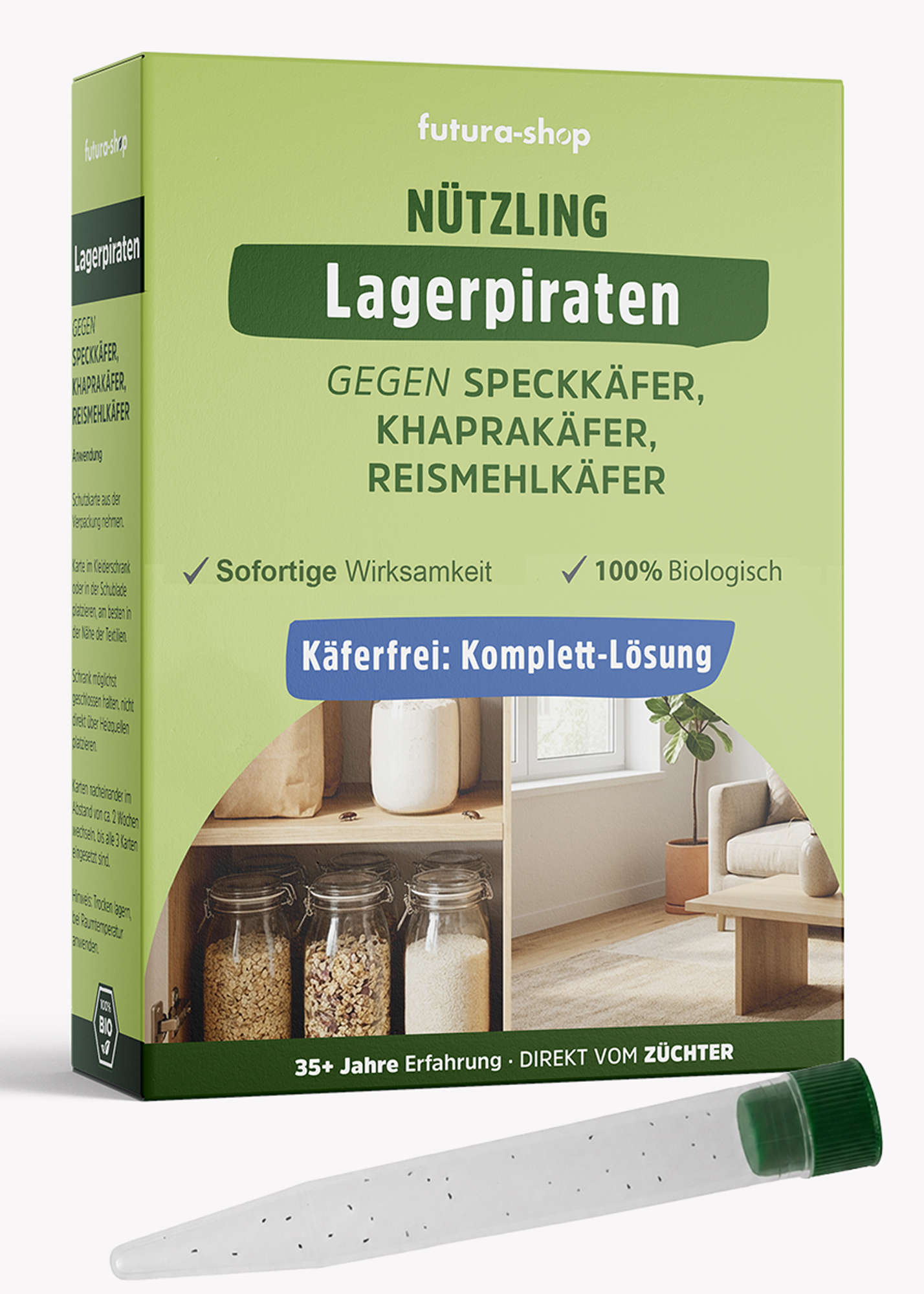
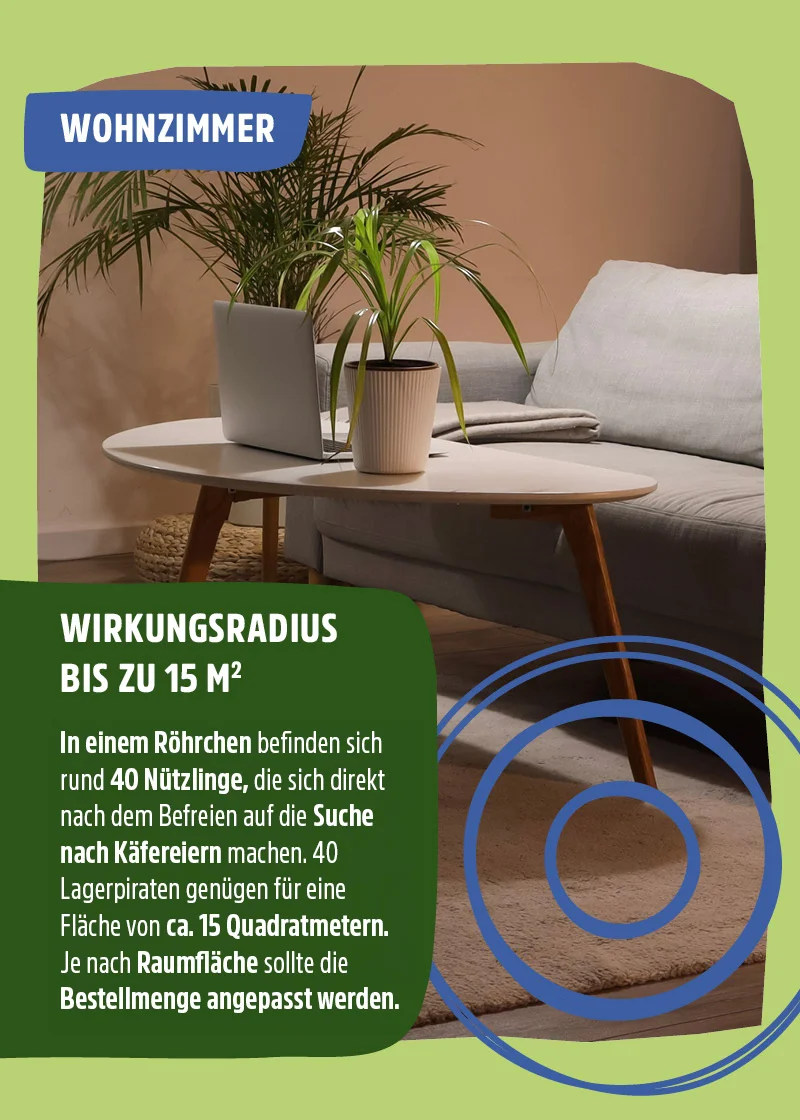
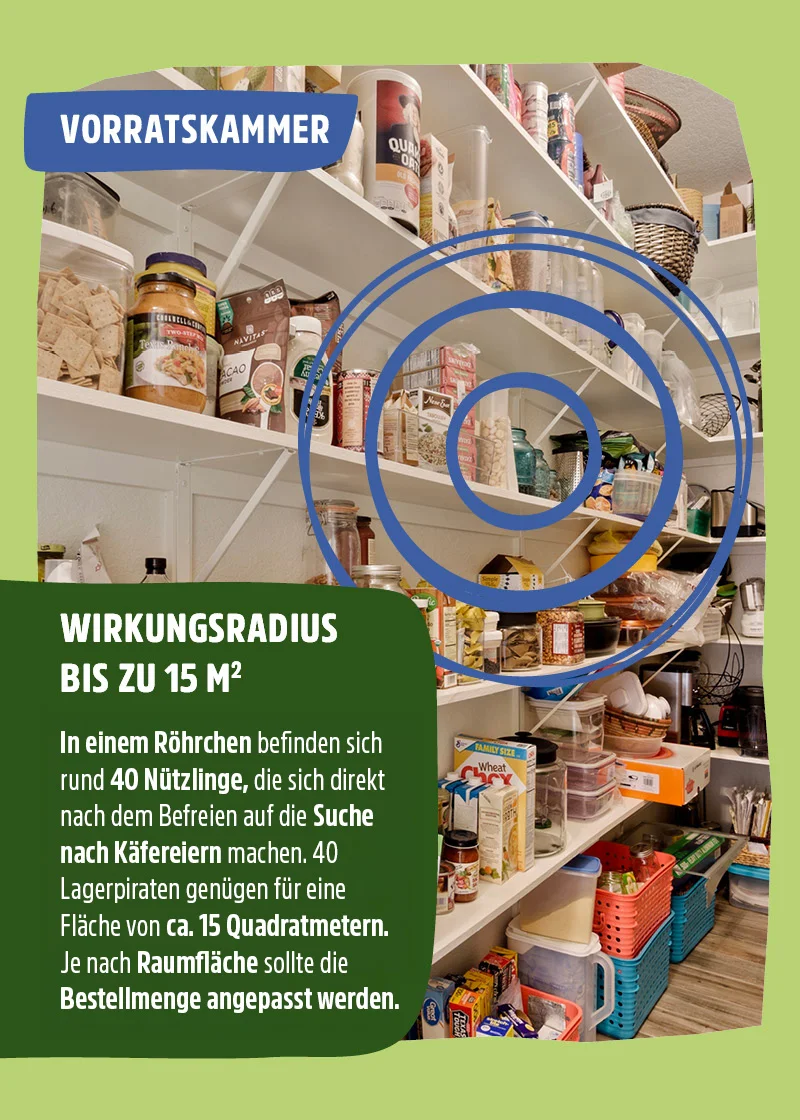
1 tube with approx. 40 warehouse pirate bugs (sufficient for a floor area of approx. 15 m²)
How do warehouse pirate bugs work against beetles? How can I control beetles with warehouse pirate bugs?
Application:
The warehouse pirate bugs are released from plastic tubes on the floor. They then find their own way to the beetle larvae. In principle, warehouse pirate bugs can be used all year round, but the temperature must be at least 20°C and at most 36°C, with a relative humidity of at least 40%. The release of warehouse pirate bugs cannot be combined with the use of synthetic chemical insecticides, as these kill the beneficial insects. Diatomaceous earth also kills warehouse pirate bugs. The only conceivable option is to use the beneficial insects before such products are applied, in order to reach development stages that the products cannot reach.
How do warehouse pirate bugs act against beetles and how long do they live?
The warehouse pirate bug eats the eggs, larvae and pupae of numerous stored product and material pests. This prevents them from developing into adult pests. A single warehouse pirate bug preys, for example, on up to 405 eggs, 4 larvae and 8 pupae of the red flour beetle. These beneficial insects are harmless to humans. The warehouse pirate bugs are active immediately. Their lifespan is 8 weeks at room temperature (21°C) and 3 weeks at 24–30°C, so depending on the temperature, the release may need to be repeated after 3–4 weeks. Once beetle control by the warehouse pirate bugs has been successful, the warehouse pirate bugs disappear too. So there is no need to worry that they will get out of hand or that you will have to get rid of them.
Warehouse pirate bugs against larder beetles – natural and effective
Have you ever heard of warehouse pirate bugs? They are small, very effective insects that do an important job for you: they are your very own pest controllers. Wait – using insects against insects? Exactly! A parasitic wasp is the ideal beneficial insect when it comes to harmful insects indoors. These include the larder beetle. This small, black-brown beetle can cause considerable damage on your premises. To prevent this, we send you our warehouse pirate bugs against larder beetles. As soon as they arrive, these practical helpers get to work.
The common larder beetle – control is necessary
Dermestid beetles are found almost everywhere. They occur on every continent and in every climate zone, with over 1,000 species. In Germany alone, 68 of them are native. Although we regard the larder beetle as a pest, it performs important tasks for the ecosystem outside your door. It is, so to speak, part of the undertaking service in forests and meadows and plays an important role in removing carrion. However, when it enters the immediate living and working environment of humans, it becomes a problem, because its larvae feed on food, textiles, furs and clothing. Their presence can also trigger allergic reactions in some people. In such a case in particular, larder beetle control must happen quickly – warehouse pirate bugs against larder beetles are the perfect method for this.
Larder beetles grow up to 10 millimetres long and are therefore visible to the naked eye. The black-brown colouring of their wings is distinctive. But how does the larder beetle get indoors in the first place? It is attracted by light and flies in through an open window. It is also attracted by decaying matter – a dead mouse in the roof space, for example, can attract its attention. Another possibility is that the larvae are brought in on textiles or similar items. Once inside, the beetle multiplies quickly – up to 6 generations can develop in a single year. As soon as you see larvae, it is time to use warehouse pirate bugs against larder beetles.
Warehouse pirate bugs against larder beetles – how to recognise an infestation
As with pantry moths and clothes moths, the beetle itself is not dangerous to humans – but the larvae are. Female larder beetles lay them in cracks and crevices. Popular spots are the niches behind skirting boards and furniture and a quiet place under the carpet, ideally close to food stores, because once the larvae have hatched, that is exactly what they feed on. They eat cheese, bacon, animal feed and anything that contains animal protein or keratin. You can recognise the larvae by their appearance: they look like caterpillars, are dark brown and appear very bushy because of their long bristles. Besides the larvae, you can recognise an infestation by what they leave behind. As they nibble their way through your food stores, they excrete strands of faeces several centimetres long. Infested clothing is noticeable by small feeding holes.
Have you discovered signs of an infestation? Then use warehouse pirate bugs against larder beetles.
Warehouse pirate bugs against larder beetles – beneficial insect vs. pest
Unlike the larder beetle, warehouse pirate bugs are beneficial insects – and you can put them to use in larder beetle control. Warehouse pirate bugs eat the eggs as well as the larvae and their pupal stages. This is how simple it is:
Order the right quantity of warehouse pirate bugs against larder beetles for your premises in our shop. To assess the infestation, use a pheromone trap, which is also available from us. A parasitic wasp can prey on up to 405 eggs, 4 larvae and 8 pupae of the pests. One tube contains 40 warehouse pirate bugs for an area of around 15 square metres.
We send your order directly to you. Make sure you give your actual address. After all, warehouse pirate bugs are living insects that should not be left in a post office box or parcel locker. We deliver them to you with care.
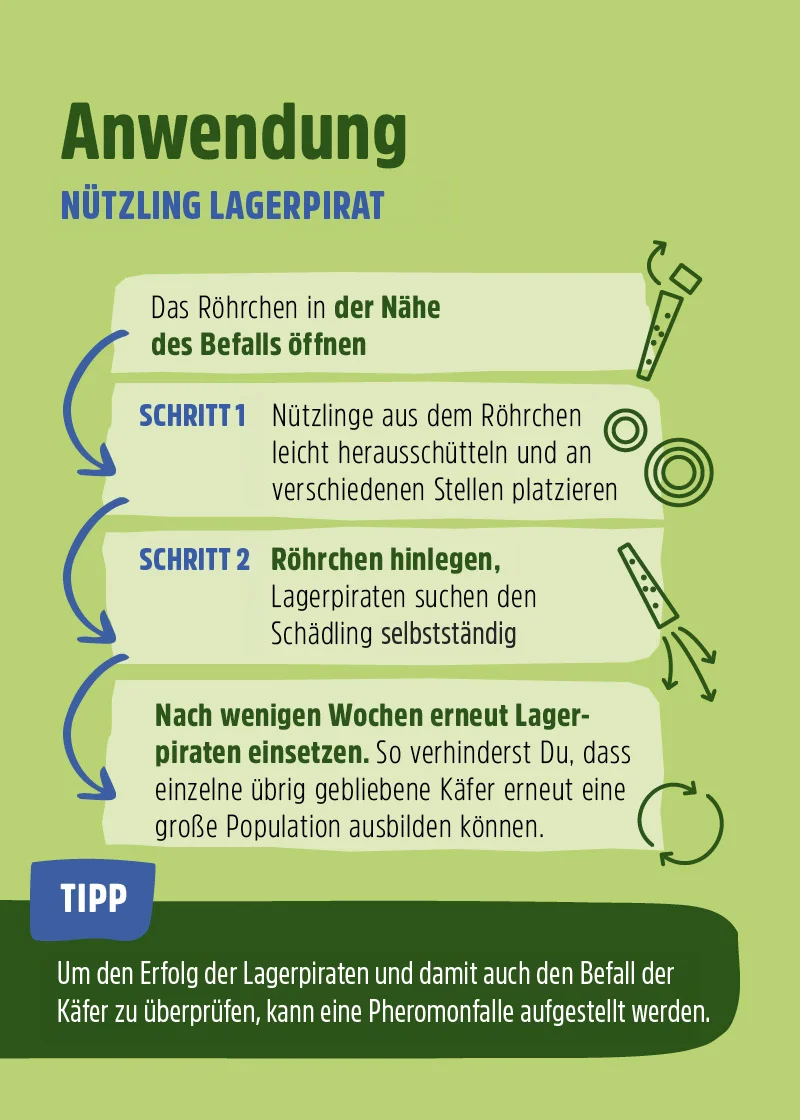
The warehouse pirate bugs against larder beetles come in a plastic tube. To release them, place the open tube on the floor, ideally right next to the infestation by larder beetles or related pests.
Once released, the warehouse pirate bugs search for their food on their own. They are ready for action immediately and attack the pests. Larder beetle eggs, pupae and larvae are destroyed by the beneficial insects. As a result, the larder beetle population can no longer grow and dies out.
Depending on the ambient temperature, the warehouse pirate bugs against larder beetles live for up to 8 weeks. A room temperature of around 21°C is ideal.
To eliminate all development stages, we recommend repeating the application after 3–4 weeks with a new order of warehouse pirate bugs.
As soon as there is no more food for the beneficial insects, they disappear from your premises – and you have them to yourself again.
Ordering warehouse pirate bugs – how to apply them correctly
Using warehouse pirate bugs against larder beetles is a simple way to get rid of the pests. For control to be truly successful, however, you must observe the following points:
Warehouse pirate bugs are living insects. Like the common larder beetle, they react to insecticides and contact poisons. If you want to use the beneficial insects, you must not apply any poisons shortly beforehand. Both diatomaceous earth and synthetic products kill these useful insects. Only use such substances once the warehouse pirate bugs have done their job.
The beneficial insects require an ambient temperature of at least 20°C and a humidity of at least 40%.
Because of the temperature requirements, delivery delays may occur – after all, we want the warehouse pirate bugs against larder beetles to arrive with you safe, sound and ready for use.
For full success, we recommend disposing of all infested food immediately and transferring new stores into airtight containers. That way you are on the safe side.
Perfect – nothing now stands in the way of using warehouse pirate bugs against larder beetles. Do not let the pests spoil your food stores any longer.
Warehouse pirate bugs against larder beetles – the environmentally friendly alternative
Controlling larder beetle larvae is not easy, because conventional products usually do not reach all development stages and hiding places. As a rule, synthetic poisons are used as soon as pests are suspected. Unfortunately, these can become a problem themselves, as in the worst case poisons trigger allergic reactions in you and the people around you. And let's be honest: poison has as little place where food is stored and prepared as the larder beetle does. Warehouse pirate bugs against larder beetles are an environmentally friendly, gentle alternative to conventional synthetic products. Using these small insects is risk-free and effective. In addition, the beneficial insects find their prey on their own. They get into small corners and find all the hiding places you would not think of. This makes them the perfect partner for larder beetle control.
| Hersteller | |
|---|---|
| Futura GmbH Nikolaus-Otto-Str. 22 33178 Borchen Deutschland Telefon: +49 5251 69161-79 E-Mail: info@futura-shop.de |
Lagerpiraten ernähren sich ausschließlich von anderen Insekten und sind für Menschen und Haustiere völlig harmlos. Sollten sie dennoch unerwünscht sein, genügt es, Kieselgur oder ein synthetisches Kontaktinsektizid in den befallenen Bereichen auszubringen. Diese Mittel töten die Nützlinge zuverlässig ab. Alternativ reicht es oft aus, alle Nahrungsquellen zu beseitigen, also befallene Lebensmittel zu entsorgen und Vorräte luftdicht zu lagern, da die Lagerpiraten ohne Nahrung nicht überleben.
Lagerpiraten sind auf Schädlinge als Nahrungsquelle angewiesen. Sobald die Käferlarven, Eier und Puppen vollständig vernichtet sind und keine Nahrung mehr vorhanden ist, finden die Nützlinge keine Lebensgrundlage mehr und sterben ab. Sie verschwinden also von selbst, ohne dass ein weiteres Eingreifen notwendig ist. Da sie mikroskopisch klein sind, bemerkt man ihr Verschwinden in der Regel gar nicht.
Lagerpiraten sind eine sehr effektive, biologische Methode zur Bekämpfung von Vorrats- und Materialschädlingen. Ein einzelner Lagerpirat kann bis zu 405 Eier, 4 Larven und 8 Puppen des Rotbraunen Reismehlkäfers erbeuten. Besonders vorteilhaft ist, dass die Nützlinge auch schwer zugängliche Stellen erreichen, an denen herkömmliche Mittel versagen. Sie sind sofort nach der Freilassung aktiv und bekämpfen Eier, Larven und Puppen der Schädlinge giftfrei und rückstandslos.
In der Regel ist bei Zimmertemperatur eine Lebensdauer von bis zu 8 Wochen zu erwarten. Bei erhöhten Temperaturen von 24 bis 30 Grad Celsius reduziert sich diese auf etwa 3 Wochen. Um alle Entwicklungsstadien der Schädlinge sicher zu erfassen, wird eine erneute Ausbringung nach 3 bis 4 Wochen empfohlen.
Die Lebensdauer der Lagerpiraten hängt von der Umgebungstemperatur ab. Bei einer typischen Zimmertemperatur von etwa 21 Grad Celsius leben sie bis zu 8 Wochen. Bei höheren Temperaturen zwischen 24 und 30 Grad Celsius verkürzt sich die Lebenserwartung auf rund 3 Wochen. Deshalb empfiehlt sich bei wärmeren Bedingungen eine Wiederholung der Ausbringung nach 3 bis 4 Wochen.