

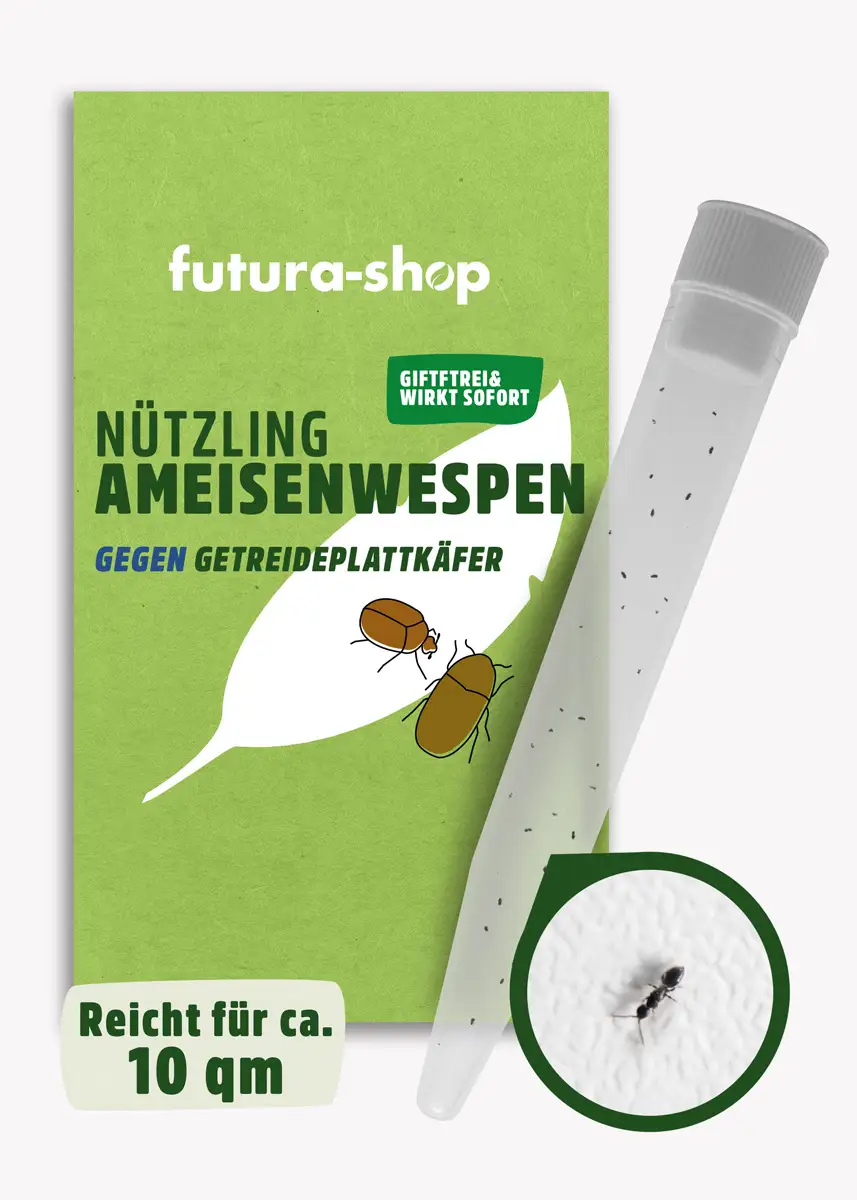
Ant Wasps | Biological Control of Saw-Toothed Grain Beetles
Available, delivery time: Versand jeden Dienstag

Product information "Ant Wasps | Biological Control of Saw-Toothed Grain Beetles"
✔ Dispatch on Tuesdays only (orders received by Monday can be included at best; dispatch is only guaranteed for orders received by Friday, 10 a.m.)
✔ Shipping is by DHL parcel.
✔ Regional weather conditions cannot be taken into account.
✔ You will receive shipment tracking.
✔ We accept no liability for undeliverable shipments due to incorrect address details or for deliveries not collected from parcel lockers or post offices.
✔ Once packing has begun, beneficial insects are excluded from exchange and withdrawal.
✔ Complaints about the goods are only accepted immediately upon receipt.
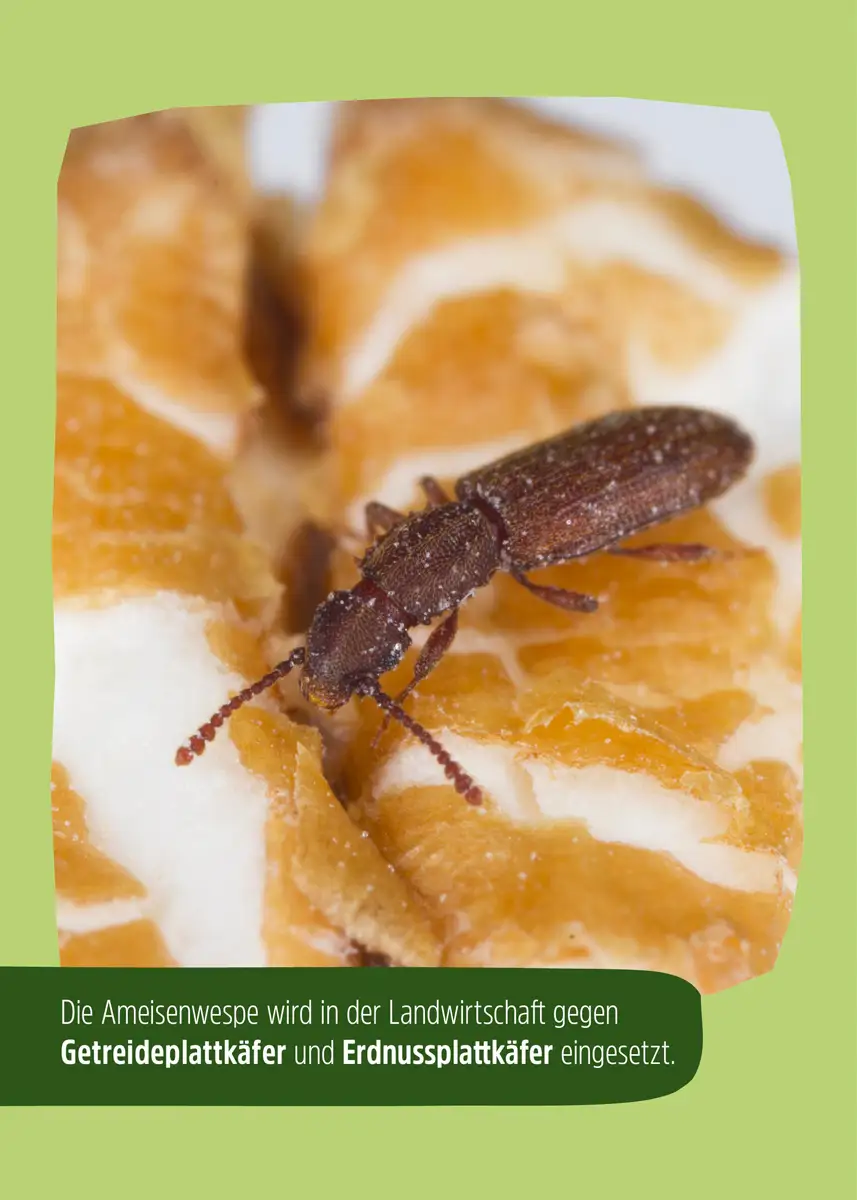
The ant wasp is used in agriculture against the saw-toothed grain beetle (Oryzaephilus surinamensis) and the merchant grain beetle (Oryzaephilus mercator). In biological pest control, the use of the ant wasp has proven to be an effective measure – entirely without pesticides. During the warmer months, the females required for pest control live for several months.
Beneficial insect
Ant wasp Cephalonomia tarsalis (Hymenoptera), Bethylidae.
Origin
Central Europe, native, bred and packaged in Germany.
Target pests
The ant wasp Cephalonomia tarsalis parasitises the larvae of the saw-toothed grain beetle Oryzaephilus surinamensis and the merchant grain beetle Oryzaephilus mercator.
Use/trade
Storage of bulk grain, grain products in agriculture and the processing industry, households
Instructions (German)
Contents
1 unit (plastic tube with lid) with at least 40 adult insects.
Biology
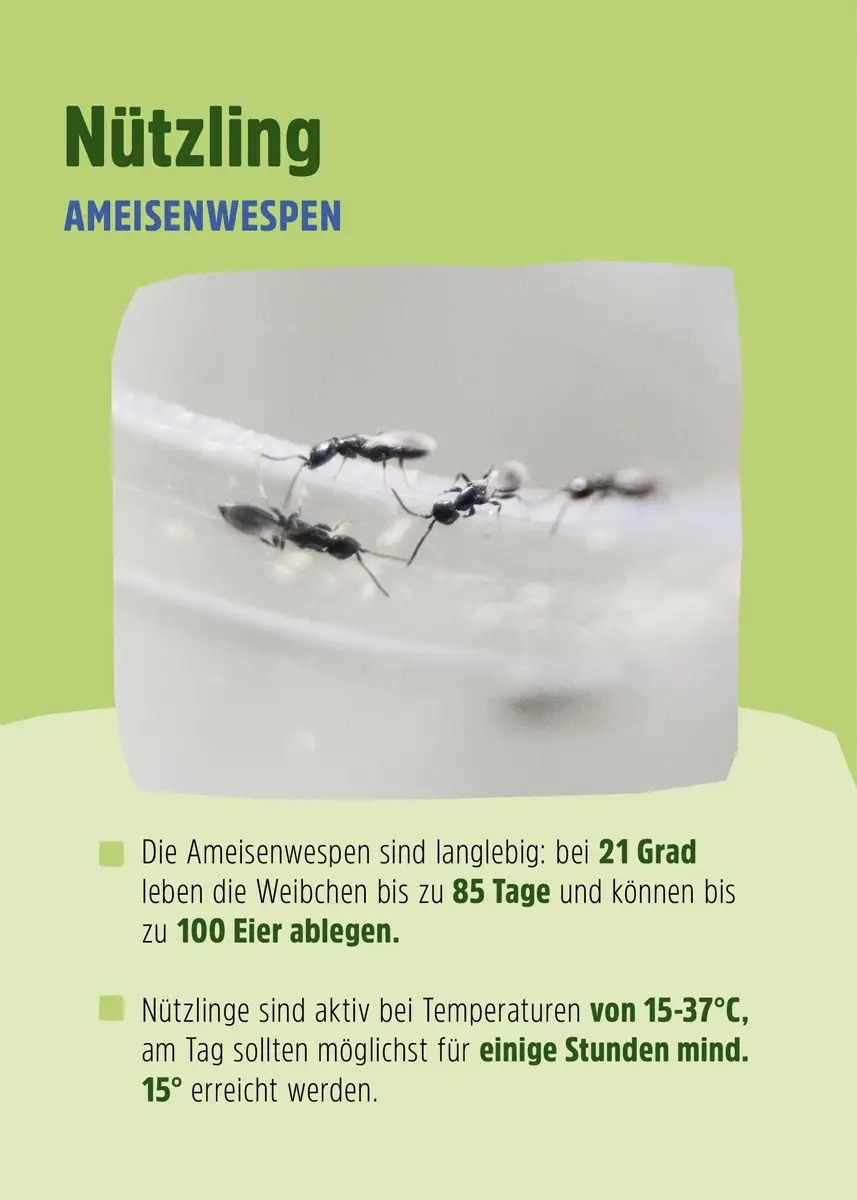
The ant wasps are long-lived: at 21°C the females live for up to 85 days and can lay up to 100 eggs. The beneficial insects are active at temperatures of 15–37°C; during the day, a temperature of at least 15°C should be reached for several hours if possible.
Application
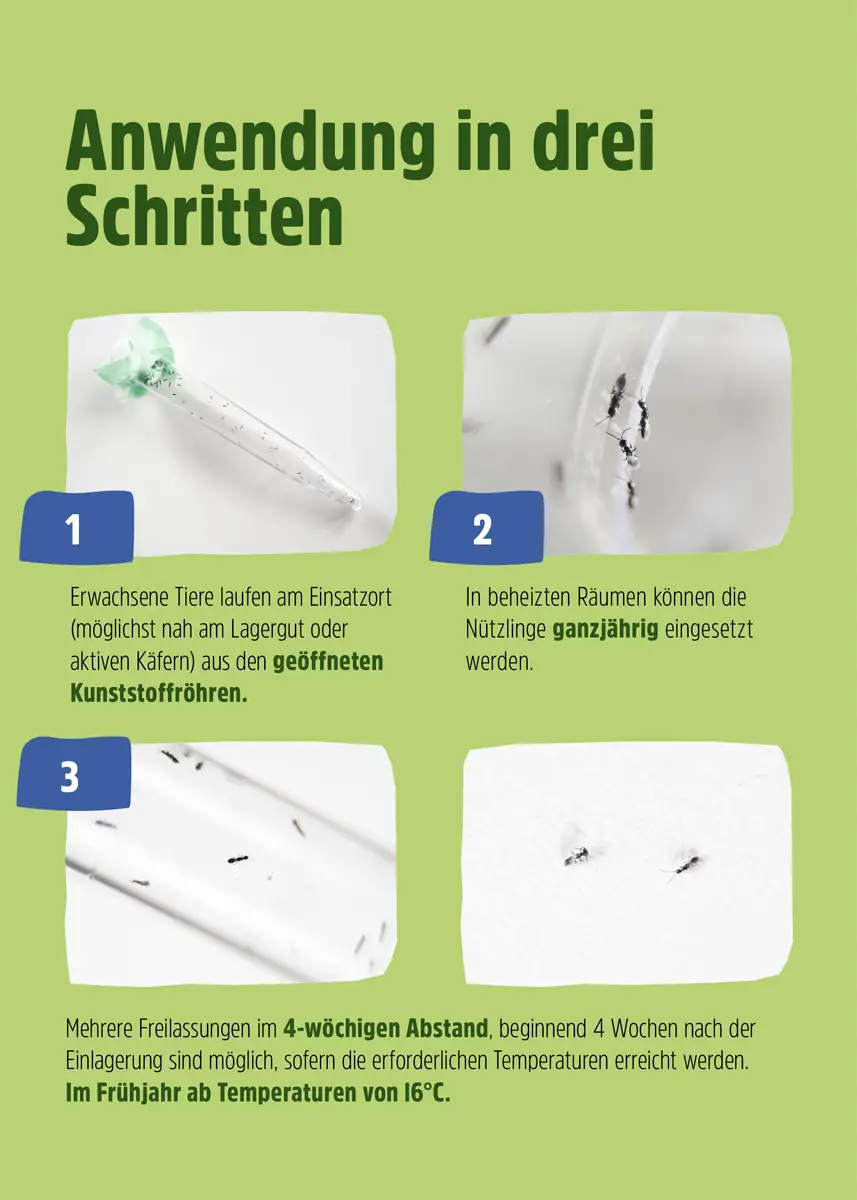
The adult insects walk out of the opened plastic tubes at the place of use (as close as possible to the stored goods or active beetles). In heated rooms, the beneficial insects can be used all year round. Several releases at 4-week intervals, starting 4 weeks after storage. Possible as long as the temperatures are reached. In spring from temperatures of 16°C.
Application rate
Storage: preventive treatment of stored grain: 2 wasps/lt grain. Empty-space treatment: 1 unit = 40 ant wasps/10 m². In households: 1 unit = 40 ant wasps/5 m².
Storage
Release as soon as possible after arrival. Do not store in the refrigerator. Store for max. 1 day above 12°C.
Caution
No chemical-synthetic insecticides (e.g. diatomaceous earth) may be used while the beneficial insects are deployed. Observe waiting periods.
Other information
The ant wasps are specialised in their target hosts. No protective measures required. No risk to users or stored grain/goods. No waiting period after release of the beneficial insects.
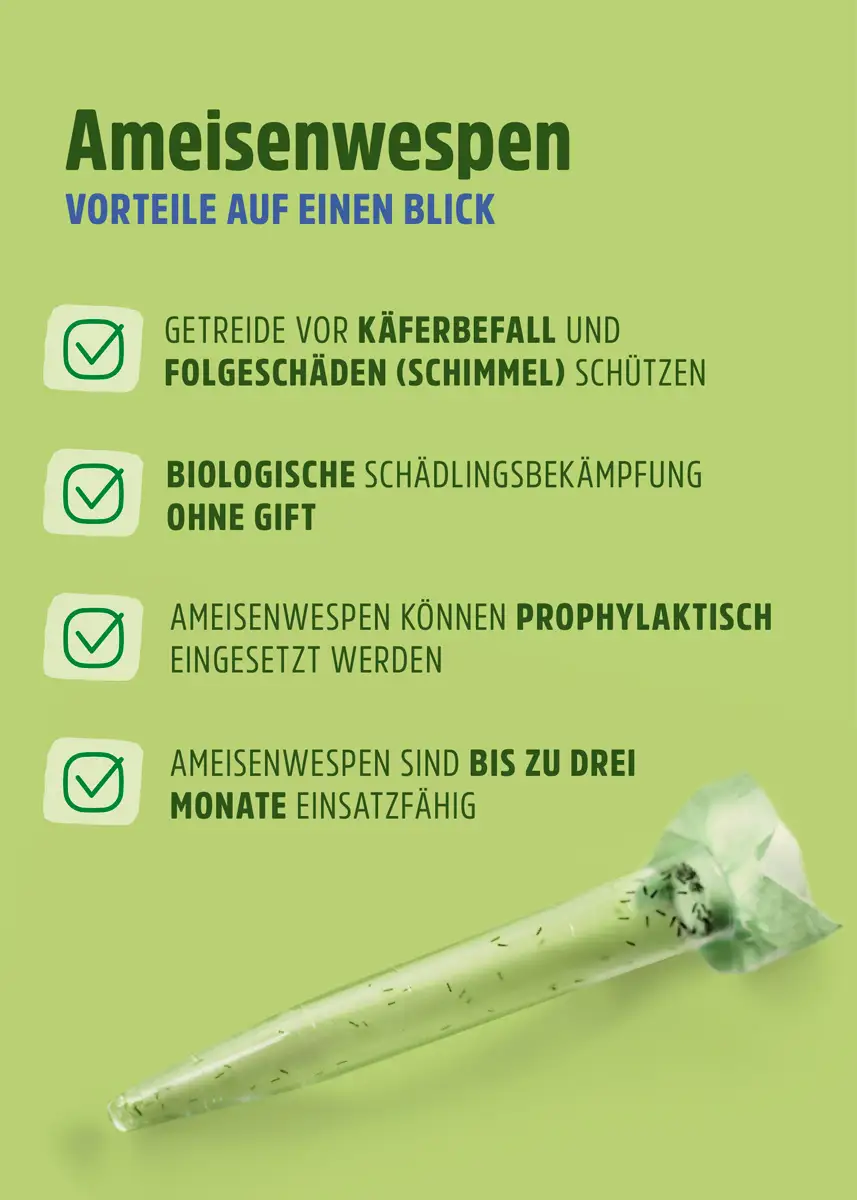
Benefits at a glance
✓ Ant wasps are biological pest controllers, so poison can be dispensed with.
✓ Ant wasps can be used preventively. For preventive pest control in one tonne of grain, just two ant wasps are effective.
✓ Ant wasps remain effective for up to three months at a temperature of 21°C.
Application: how do I use ant wasps?
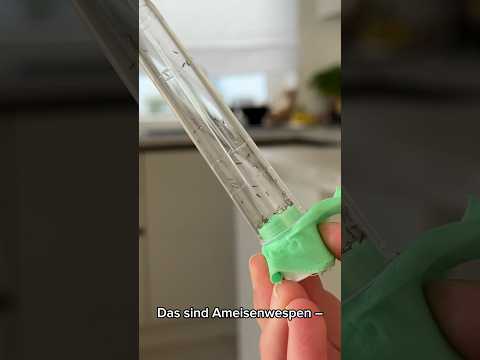
The scope of delivery comprises 40 ant wasps. The ant wasps are supplied in a plastic tube in which they have been enclosed for safe transport. On arrival, you should release the wasps promptly at the place where you want to eliminate the pests. To do so, carefully open the tube. There is no need to worry about the wasps flying towards you, as the females have no wings. Nevertheless, you should be careful. Once the tube is open, you can simply leave it undisturbed. The ant wasps can walk out on their own. Please do not shake them out, as this poses a risk of injury to all involved.
Getting rid of troublesome saw-toothed grain beetles with ant wasps
Although ant wasps have other prey in the wild, they readily attack the larvae of the saw-toothed grain beetle if nothing better is available. But why should you want to get rid of the saw-toothed grain beetle in the home or in agriculture at all? These dark brown beetles can cause considerable damage, as the appetite of these insects, just 2.5 to 3.5 millimetres in size, is far greater than their body size would suggest. Their favourite food includes all kinds of cereals and cereal products. For this reason, the insects occur above all in grain stores, food businesses and even in the average kitchen cupboard. Nor do these tiny creatures stop at nuts such as almonds or other carbohydrate-rich products.
The first problem is that the saw-toothed grain beetle starts feeding in the larval stage. The female burrows deep into the chosen food source and lays her eggs there. Once the larva has hatched, the big feast begins. As the female lays around 300 eggs, the stores are gone faster than you can say "saw-toothed grain beetle". An even more serious problem, however, is the consequential damage: the feeding causes mould, and the infested grain becomes damp, lumpy and can no longer be processed. In addition, saw-toothed grain beetles encourage further infestation by other pests such as the grain weevil. To prevent damage on this scale in the first place, the ant wasp can be used as non-toxic, effective, biological pest control.
Ant wasps: development in the wild
In science, ant wasps are called "Mutillidae". There are around 4,300 species of ant wasp worldwide, grouped into 210 genera. Only around 155 species have been observed in Europe so far. According to current knowledge, nine species live in Germany. Most ant wasp species are native to the tropics and subtropics. Most ant wasp species are assigned to the subfamilies Sphaeropthalminae and Mutillinae. In their development into adult ant wasps, the species have much in common.
Female ant wasps handle brood care in a similar way to female cuckoos: not at all. Their most important task is to find a suitable host in which to smuggle their eggs. For finding a host, the female ant wasp is equipped with special antennae. The flightless female ant wasp enters the host's nest through the main entrance. In doing so, she often provokes the wrath of the nest guards of social insect species such as bees. However, the ant wasp often wins such a fight. Once she has successfully entered the nest, the ant wasp has an easy job and seeks out the host's brood.
There, in most cases, she lays one of her eggs next to an egg of the host. Depending on the host species, the wasp sometimes first has to open a cocoon or a cell, which she then carefully closes again. If the ant wasp assumes that the host larva could be too strong, she also paralyses it with a small amount of venom, which helps her offspring to feed. Sometimes the female ant wasp spends several days in the host's nest. The larva hatches after about four days. Once the young ant wasp has hatched, it eats the host larva completely and then pupates. The metamorphosis into a fully developed ant wasp takes several days, after which it leaves the host's nest. Adult ant wasps usually feed on nectar or their hosts' honey pots.
Controlling saw-toothed grain beetles: why the ant wasp is so effective
Ant wasps are very effective pest controllers, as they kill their victims almost unnoticed by serving the foreign larvae to their own offspring as food on a silver platter. Just like parasitic wasps, ant wasps attack the larvae of other insects. In the case of parasitic wasps, these are grain weevils, for example. For ant wasps in pest control, the larvae of the saw-toothed grain beetle are on the menu. In the wild, ant wasp larvae feed mainly on bumblebee larvae. The mother lays her eggs in bumblebee nests. After both types of larvae have hatched, the ant wasp larvae feed parasitically on the larvae of their host.
A major advantage of ant wasps is that in reality they have hardly any predators. Ant wasps have well-developed defence strategies that make it almost impossible for potential predators to add them to their menu. For the sake of completeness, terrestrial vertebrates in particular are among the predators of ant wasps, as are amphibians such as frogs and toads, and certain reptiles such as lizards or snakes. But what defence strategies mean that the ant wasp officially has predators while unofficially putting every enemy to flight?
In the animal world, a distinction is made in the predator-prey relationship between primary defence (everything that repels the predator before the attack) and secondary defence (everything that serves as defence during the attack). The primary defence of the female ant wasp includes burrowing into the ground and playing dead. The females can keep this up for several minutes and thus cannot be discovered even by more intensive digging. In addition, many ant wasp species have a strongly coloured body. One example is a female of the genus Dasymutilla, whose red, furry body is one big warning. In some cases, however, the conspicuous body actually attracts predators, especially those that have not yet encountered the ant wasp's defences.
Another defensive advantage is the ant wasp's very sturdy armour. This is known technically as the exoskeleton and impresses with its protection against desiccation and its very high breaking strength (10 times that of honeybees). The predator's first bite therefore rarely causes damage. In the second step, the secondary defence comes into play. This consists almost exclusively of the ant wasp's extremely painful sting. The venom, administered through the extendable and swivelling sting, is not particularly life-threatening, but it causes the predator such pain that it will never attack ant wasps again. The defence mechanisms are so effective that even harmless insects with a similar visual pattern are also avoided.
| Hersteller | |
|---|---|
| Futura GmbH Nikolaus-Otto-Str. 22 33178 Borchen Deutschland Telefon: +49 5251 69161-79 E-Mail: info@futura-shop.de |